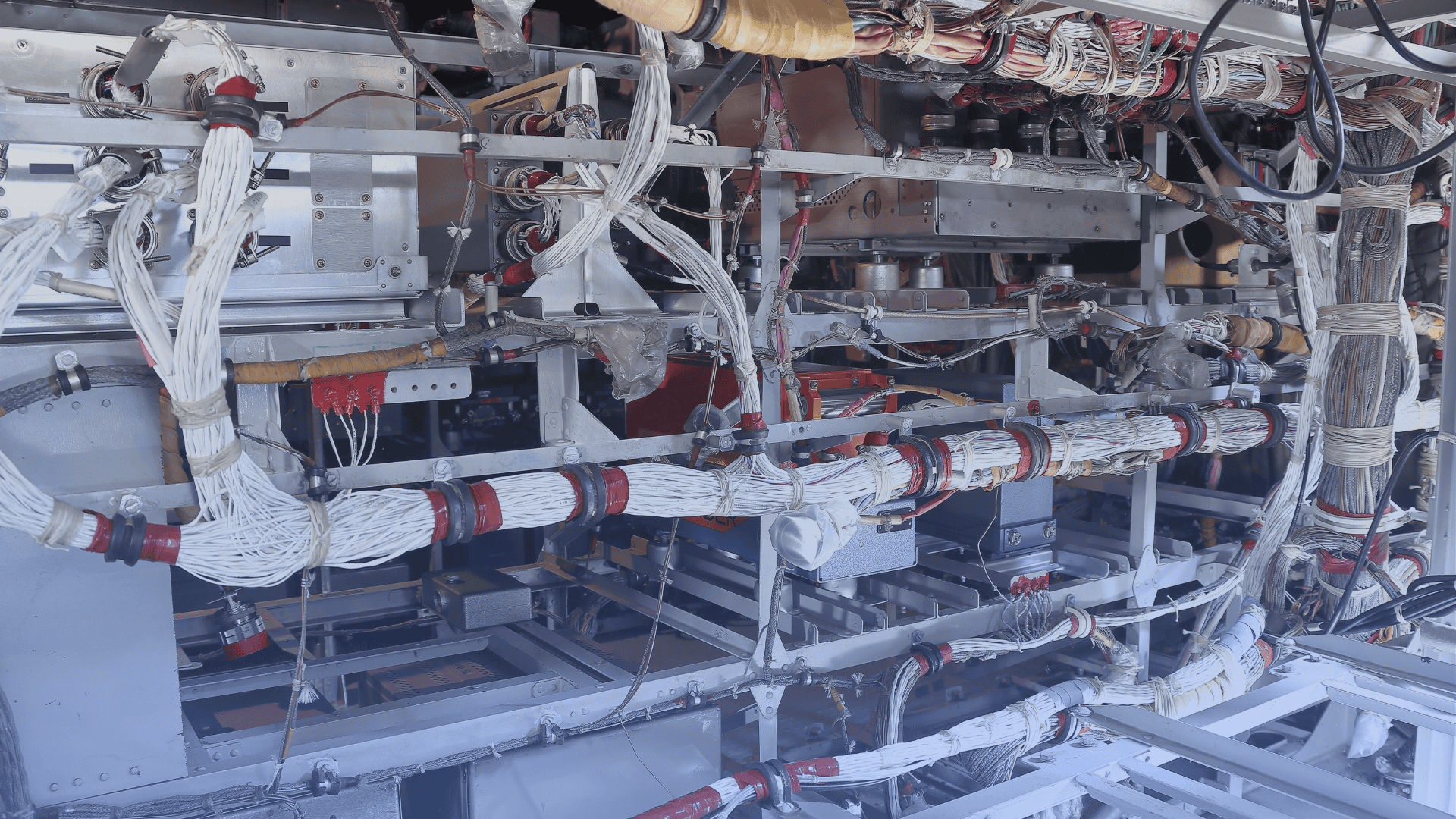
Wiring harness design is becoming an architecture decision, not a downstream task. See why engineering leaders are rethinking cable routing, zonal architectures and AI-driven design exploration — and what it means for cost, time-to-market and risk.
If you run engineering for a vehicle or complex-machine program, you already know the electrical architecture is never really the problem — until it is. It shows up late, it's expensive to unwind, and by the time it surfaces, most of the decisions that caused it were made months earlier, by other teams, for other reasons.
That's the pattern worth interrupting.
For decades, the sequence was simple: fix the architecture, place the components, freeze the packaging, and only then figure out how to wire everything together. It worked when electrical content was modest and change was rare. It doesn't work as well now. Your products carry more electronics, more sensors, more compute and more electrical functions than any previous generation — while you're simultaneously expected to cut weight, control cost, simplify assembly and compress the schedule. The wiring harness sits exactly where those pressures collide, which is why it's increasingly a program-level risk, not just an engineering deliverable.
What's actually changing isn't the harness itself. It's where in your process the decisions that determine the harness get made. The routing outcome is increasingly locked in before routing even starts — which means the leverage has moved upstream, and so should your attention.
More electronics doesn't have to mean more wiring, if the architecture is right
Look at what's happening with zonal electrical architectures.
Instead of running a dedicated connection from every sensor and actuator back to controllers scattered across the platform, zonal architectures group nearby functions around a local controller, which then talks to central computing through a small number of backbone connections. NXP and Aptiv are already building platforms around this model as the industry moves toward software-defined vehicles — and it's a good proxy for where the rest of the market is headed.
The headline benefit is shorter cable runs and simpler wiring. The strategic point, for you, is different: the architecture itself now determines most of the final harness outcome, before any engineer opens a routing tool.
Move a controller, and cable lengths shift across the board. Reassign a function to a different zone, and part of your topology changes with it. Reorganize power distribution, and an entire branch can disappear — or a new one can appear that nobody budgeted for. Each of those is an architecture decision with a direct line to cost, weight and program risk.
That reframes the question your teams should be asking. Not "how do we optimize the routing of this harness," but "is this the right architecture to route in the first place?" The second question is the one that protects your budget and your schedule. It also has to be asked earlier than most organizations are currently set up to ask it.
Routing a frozen architecture only gets you so far, and it costs you
Here's the constraint your teams are working under once harness design starts after everything else has already been decided.
Components already have positions. Interfaces are already defined. Packaging space is already claimed by mechanical systems. A skilled harness design engineer can still find a better path through what's left — but the design space is already boxed in, and so is your cost structure.
It's a bit like commissioning the best possible road network after every building in the city has already gone up. You can optimize the roads all you want. The decisions that mattered most were made before the project reached you.
Harness engineering runs into the same wall, and it shows up on your program as late change orders, schedule slips and rework that eats engineering capacity you'd rather spend elsewhere. Shift one component a few centimeters and you might eliminate your worst routing problem entirely. Relocate a controller and several branches get shorter at once. Regroup functions differently and you cut complexity far more than any amount of downstream optimization ever could.
The reason most organizations don't do this routinely is that evaluating those alternatives by hand is genuinely hard — every change ripples into several other parts of the product, and few teams have the bandwidth or the tooling to trace that ripple reliably. That's the capability gap worth closing, because it's the difference between discovering a harness problem in verification and never having created it in the first place.
The shortest route is rarely the best business decision
It's worth retiring "minimize cable length" as your default success metric, because on its own, it's the wrong target.
The shortest cable path can look attractive in a bill of materials and still cost you more downstream — awkward bends, harder installation, worse serviceability, or a design that only works for one variant instead of your whole product family. A slightly longer route might be dramatically cheaper to manufacture. An architecture with one extra component might simplify everything downstream of it enough to pay for itself several times over. A design that uses more cable in one area might deliver far better reuse across variants, which matters a great deal if you're managing a platform rather than a single product.
This is why harness optimization isn't really a geometry problem — it's a portfolio decision. You're balancing cable length, mass, cost, assembly effort, available space, accessibility, manufacturing constraints, product variants and your own internal design rules, all at once. The value your organization captures comes from finding the best compromise across all of those dimensions simultaneously, not from minimizing any single one. That's a design-exploration capability, not a routing capability — and it's worth staffing and tooling accordingly.
New power architectures are raising the stakes
Changes in vehicle power distribution are pushing in the same direction, and they're worth putting on your roadmap now rather than reacting to later.
The growing use of 48V architectures alongside conventional 12V systems opens new options for how power moves through a vehicle, potentially lowering current requirements and conductor material for certain loads. But it also hands your teams a new set of architectural decisions: where power distribution happens, where voltage conversion takes place, which loads get grouped together, where local controllers sit.
Every one of those decisions lands directly on your harness — and therefore on your cost, weight and manufacturability targets. The old organizational line between "electrical architecture team" and "harness/mechanical routing team" is getting harder to justify, because the two now shape each other too strongly to be handed off sequentially. If your teams are still organized around that handoff, the 48V transition is a good forcing function to reconsider it.
Harness design is becoming part of product architecture, and that's an opportunity, not just a risk
This is probably the most consequential shift for how you run engineering.
Historically, the harness was treated as an output: architecture defines what needs connecting, mechanical design decides where components live, and harness engineering finds a way to wire it up. That relationship no longer has to run in one direction — and organizations that keep treating it as one-directional are the ones absorbing the most rework.
Harness complexity can and should influence where a component gets placed. Routing feasibility can influence controller location. Manufacturing constraints can shape branch structures. Variant strategy can determine how connections get grouped. In other words, the harness is becoming an input to product architecture, not simply a consequence of it.
For you, that opens a genuinely new lever: comparing architectures before committing to one, using harness impact as a decision criterion alongside cost, performance and manufacturability. Your teams could evaluate several controller placements and immediately see the effect on total cable length and mass. They could compare function groupings and identify which produces the simplest, most manufacturable harness. They could stress-test branch structures or packaging layouts before a single hour of detailed CAD work is spent. Instead of discovering routing problems after the architecture is frozen — when fixing them is slowest and most expensive — your organization gets to use harness performance as one of the criteria for choosing the architecture in the first place.
Where AI actually creates value here, and where it doesn't
Most of the current conversation about AI in engineering is about generation: generate a geometry, generate a layout, generate a route. If that's how you're evaluating AI for harness design, you're likely underestimating both the risk and the opportunity.
Producing a cable path is the easy part. Proving that path is technically and commercially sound is the hard part. A route can look perfectly reasonable and still violate a rule or requirement you care about — it might cut through a forbidden zone, force an unmanufacturable bend, or quietly break the connectivity defined by your electrical architecture. An AI tool that only generates routes faster just lets you make the same category of mistake more quickly.
The real value of AI for wiring harness design is different: the ability to generate and compare a much larger number of technically valid alternatives than any team could produce manually — one that minimizes cable length, another that simplifies assembly, another that reduces branch count, another that maximizes reuse across variants — and to do it fast enough to inform decisions while they're still cheap to change.
Your engineers still make the call. What changes is how much of the design space they get to see before they make it, and how much of your organization's engineering capacity is spent on manual iteration versus on judgment. That's the return on investment worth evaluating: not "can AI draw a route," but "how many more good options can my team see before the architecture is locked, and how much rework does that eliminate downstream."
The real bottleneck is disconnected engineering information
There's a second reason this problem is hard, and it's organizational as much as technical: the information your teams need rarely lives in one place.
Electrical connectivity lives in one system. Component geometry lives in CAD. Routing constraints live in internal documentation. Manufacturing rules live somewhere else again. Product variants are managed in yet another tool. These systems are often digitally connected without the engineering logic between them ever actually being encoded — which means the connection exists on paper but nobody's software can reason about it.
A connection can exist in the electrical architecture and simply be missing from the physical design. A connector can sit in CAD referencing the wrong component. A route can be geometrically perfect and still violate an internal rule that nobody checked before release. Each of these is a quality escape waiting to happen, and each one is expensive in proportion to how late it's caught.
This is part of why the industry is moving toward more structured electrical and harness data. Initiatives like VEC, from prostep ivip and VDA, aim to make electrical-system information more consistent and machine-readable, while newer manufacturing standards improve data continuity further downstream. The standard itself isn't the point. What it unlocks is: once the information is structured, software can compare the electrical definition against the physical design, apply your rules consistently, trace changes, and evaluate candidate architectures using the same logic your engineers already apply manually — just faster, more consistently, and earlier. That's the foundation real engineering intelligence has to run on, and it's a capability gap most organizations still have.
What Dessia does about this, and the business case for it
This is where Dessia's work is aimed, and it's built specifically for the problem described above: not only automating routing, but giving your organization the ability to explore and compare architectures before you commit to one.
Concretely, that means electrical connectivity gets represented as structured relationships, the physical product gets understood geometrically, and your engineering rules get formalized and digitalized so they can be applied automatically and consistently — instead of depending on one senior engineer's memory. From there, candidate routes and architectures can be generated, evaluated and compared against the technical and business criteria that matter to your program: cost, mass, manufacturability, accessibility, and reuse across variants.
For engineering and program leaders, that translates into a few concrete outcomes:
- Fewer late-stage surprises. Conflicts between electrical intent and physical design get caught while the architecture is still cheap to change, not during verification when a fix means a schedule slip.
- Faster architecture decisions, with evidence behind them. Your teams can compare controller placements, zonal groupings or power-distribution strategies in hours, not weeks, and back the decision with quantified trade-offs rather than intuition alone.
- Lower engineering rework and better use of scarce senior talent. Instead of your best harness engineers manually iterating between a handful of options, they spend their time on judgment calls across a much wider, machine-generated set of valid alternatives.
- Better scalability across variants and platforms. Because rules and connectivity are formalized rather than tribal knowledge, evaluating a new variant or a platform derivative becomes a comparison exercise, not a redesign from scratch.
- A layer of engineering intelligence on top of what you already run. The intent isn't to replace your CAD, electrical-design or PLM systems — it's to connect them with a layer that understands how electrical connectivity, physical geometry and engineering rules relate to each other, so decisions made in one system are automatically checked against the constraints that live in the others.
That combination — de-risking architecture decisions earlier, freeing up senior engineering capacity, and scaling more cleanly across variants — is what changes harness design from a cost center you manage to a lever you can use competitively, particularly on programs where harnesses have to coexist with dense mechanical environments, numerous configurations and strict design constraints.
The future of harness design starts before the first wire
The next generation of wiring harness design won't be won with better routing algorithms alone.
Zonal electrical architectures, new power-distribution strategies, increasingly complex electronics and better-connected engineering data are changing the problem itself. Harness design is becoming an architecture decision — which means the biggest gains available to your organization won't come from routing the same design faster, but from finding a better design before routing even begins.
That's a different opportunity than the one most engineering organizations are currently structured around. By moving harness engineering upstream, you give your teams the ability to evaluate more possibilities, understand trade-offs earlier, and avoid locking your program into architectures that are expensive to route, manufacture or scale — which is ultimately a cost, schedule and competitiveness decision as much as an engineering one.
The future of harness design doesn't start with the first cable. It starts with the first architecture decision — and increasingly, with whether your organization has the tools to make that decision well.
Frequently asked questions
Why should engineering leaders care about wiring harness design specifically?
Because the harness is where electrical architecture, mechanical packaging and manufacturing constraints all collide — and by the time harness problems surface, they're usually the most expensive kind of change to make. Treating harness design as a downstream task rather than an architecture input is a common source of late-stage rework, schedule slips and unplanned cost.
What is a zonal electrical architecture, and what's the business impact?
A zonal architecture groups nearby sensors, actuators and devices around local controllers, which connect to central computing through fewer backbone connections. Beyond simplifying wiring, it means architecture decisions — controller placement, function grouping — now determine most of the harness outcome, so evaluating those decisions early has a direct effect on cost, weight and time-to-market.
What's the actual business case for AI in wiring harness design?
The value isn't generating routes faster — it's evaluating far more technically valid design alternatives than a team could produce manually, and doing so early enough to influence architecture decisions while they're still cheap to change. The return shows up as fewer late-stage design changes, better use of senior engineering capacity, and architecture decisions backed by quantified trade-offs instead of intuition.
What does Dessia actually do for harness engineering?
Dessia adds an intelligence layer on top of existing CAD, electrical-design and PLM systems — representing electrical connectivity as structured relationships, formalizing engineering rules, and generating and comparing candidate routes and architectures against your technical and business criteria. The goal is to let engineering and program leaders compare architectures and catch conflicts before commitments are frozen, rather than automating routing after the fact.