Product updates
Dessia launches Lagrangia 1.0, its first AI model. This DeepAgent automates knowledge structuring, agent creation, and 3D CAD verification—no code needed.
8 min reading

Dessia launches Lagrangia 1.0, its first AI model. This DeepAgent automates knowledge structuring, agent creation, and 3D CAD verification—no code needed.
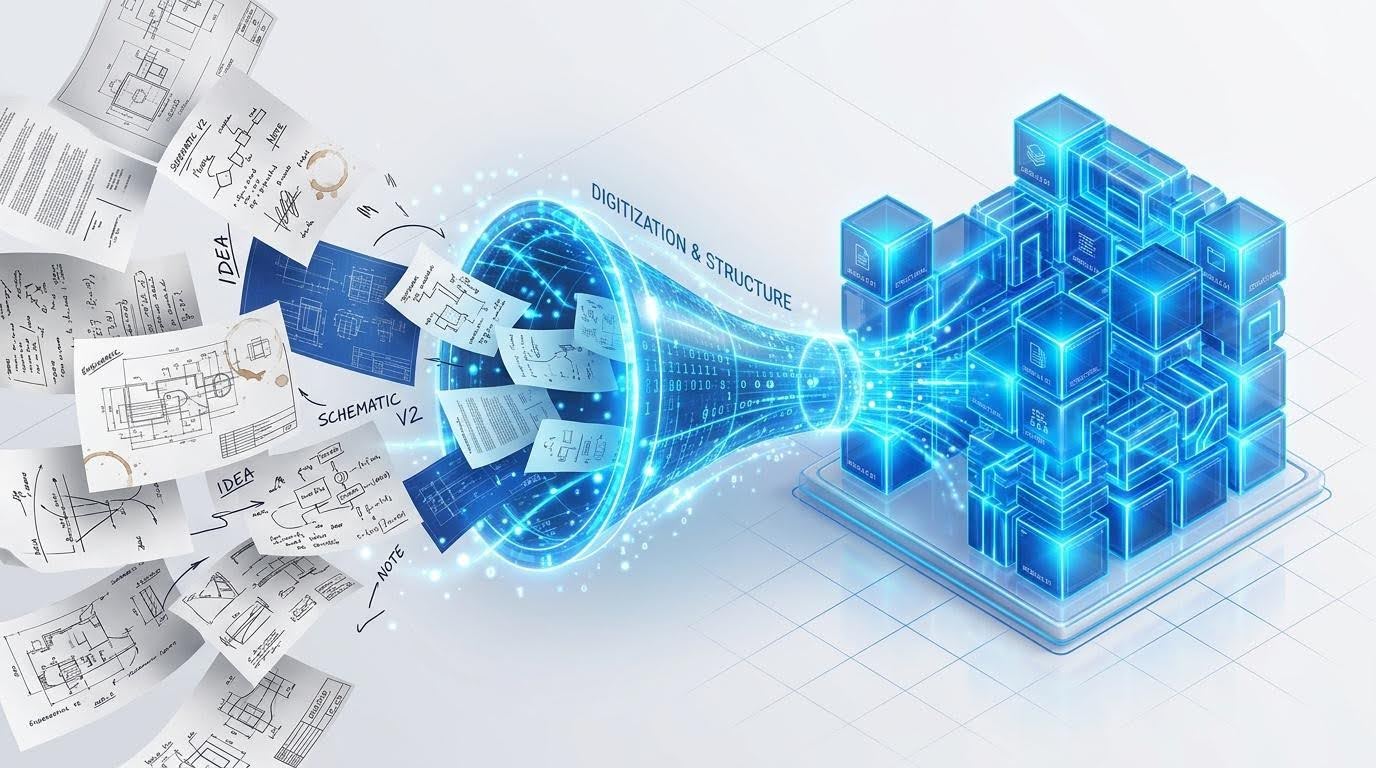
In the world of industrial engineering, a large portion of domain expertise remains locked inside the minds of experts. Design rules, critical verifications, complex workflows—all of this knowledge exists, but rarely in a digital, reusable, and automatable form. At Dessia, we have been working for several years to change that. Today, we are reaching a major milestone with Lagrangia 1.0 model, Dessia’s very first AI model.
Dessia is a platform dedicated to the structuring and reuse of engineering knowledge, with a particular focus on 2D and 3D data. In practice, the platform enables developers and engineers to capture their know-how in the form of workflows, algorithms, and executable engineering agents.
Today, this entire process is declarative and deterministic: it is the developer who manually structures the knowledge, defines the workflows, and builds the agents that execute them. Knowledge creation is manual. Knowledge reuse is manual. And the use of these agents is manual as well. This approach has proven its value—but it has reached its limits in terms of scalability.
Implementing knowledge and emulating it through agents are tasks that require enormous amounts of time and back-and-forth with the end user. Each new functional scope demands significant structuring effort, repeated updates, and continuous coordination between business and technical teams.
“Will the structuring of this knowledge and the creation of an agent for this scope be cost-effective?” This is the question engineering organizations are asking—not in the technical sense, but in terms of investment.
This very CAPEX-driven mindset severely limits the scalability of agent deployment within engineering organizations. Teams hesitate to invest time in digitalizing their domain rules if they are not certain of the return on investment. The result: a large portion of knowledge remains unstructured, non-reusable, and therefore non-automatable.
The Lagrangia 1.0 model is the first AI model developed by Dessia. It is an “agentic” architecture—a DeepAgent—designed to augment the Dessia platform along two fundamental dimensions: the automatic structuring of knowledge and the automated construction of agents.
This DeepAgent is capable of autonomously performing three key functions:
In other words, the Lagrangia 1.0 model takes over what was previously done entirely by a developer: identifying the right knowledge building blocks, ensuring their consistency, and assembling them into a functional agent. The central objective is to reduce—or even eliminate—the time spent customizing knowledge, so that each business team can build its own agent tailored to its specific needs.
Beyond knowledge management, the Lagrangia 1.0 model integrates an additional capability: generating CAD geometry directly from a natural language prompt. In this first version, the model can construct simple sketches and elementary volumes that serve as the foundation for advanced 3D data science reasoning.
Specifically, the Lagrangia 1.0 model is capable of generating ephemeral CAD—that is, geometric objects built on the fly, not intended to be part of the final design model, but rather to feed a broader engineering reasoning process.
Concrete example: automatic screwdriver accessibility verification. On a bolted assembly, the model detects the screws present in the CAD, then automatically generates a cone and a cylinder representing the clearance volume required by the automatic screwdriver. This ephemeral CAD—consisting of the cone and the cylinder—is then used to verify that there is no interference between this volume and the other elements of the assembly. The model thus constructs an elementary geometric building block in service of a broader reasoning objective: ensuring that the assembly tooling is compatible with the 3D environment.
It is important to note that in this version 1.0, the CAD elements generated by the model remain rudimentary—simple sketches, cones, cylinders, basic volumes—but their value lies precisely in the fact that they are generated on the fly by the AI model to support automated verifications that would otherwise require manual intervention.
One of the most common challenges in engineering organizations is the verification of 3D objects. Engineers have domain rules—rules on paper, rules structured in their minds—that are not digitalized, not easily reused, and therefore impossible to automate at scale.
With the Lagrangia 1.0 model, it becomes possible to chain this type of workflow directly from a prompt:
What this workflow describes is data science applied to CAD—without the engineer needing to write a single line of code. The Lagrangia 1.0 model digitalizes all this business logic, transforms it into elementary tools, and orchestrates them automatically to produce an actionable result. This is precisely where the value of the model lies: making the Dessia platform scalable across all engineering domains that deal with 3D.
In this version 1.0, the Lagrangia model specializes in data science applied to 3D CAD. It can address challenges related to shape search, pattern recognition, distance calculation, and the construction of abstract and virtual points in 3D space—all operations that serve as the foundation for engineers’ domain reasoning.
The next step on our roadmap is the Lagrangia 2.0 model, which will extend these capabilities to reasoning on 2D drawings—thereby opening Lagrangia to even broader coverage of engineering topics, from design through to document validation.
The Lagrangia 1.0 model is a foundational milestone in Dessia’s vision: transitioning from a platform where knowledge is structured manually to one where AI handles this structuring autonomously, without redundancy, and oriented toward the creation of business-specific agents that are ready to use.
For engineering teams, this concretely means less time spent coding workflows, fewer questions about the profitability of digitalization, and the ability to deploy agents across new business scopes much faster than before.

Published on
07.10.2026
These articles may be of interest to you
Product updates
Dessia launches Lagrangia 1.0, its first AI model. This DeepAgent automates knowledge structuring, agent creation, and 3D CAD verification—no code needed.
8 min reading
Product updates
Dessia v3.2.0 introduces automated Verification & Validation and visual Solution Landscapes for trade-off analysis. Rule governance becomes scalable, validation runs in parallel on 2D/3D models, and engineering teams compare solutions instantly to accelerate decisions.
7 min reading
Product updates
July 2025 - A New step in AI industrialization for 3D modeling and design
4 min reading