AI generative design can explore thousands of design options in minutes. But some critical aspects of engineering still require structured knowledge and human judgment.
AI generative design is powerful — but it still can’t do these 5 things
The real limits of AI in engineering design
Artificial intelligence has rapidly become one of the most talked-about technologies in engineering.
From generative engineering to AI-driven design automation, the promise is clear: algorithms can explore vast design spaces, generate thousands of potential configurations, and accelerate product development cycles.
The concept of AI-based generative design is particularly compelling. Instead of manually designing one solution at a time, design engineers define objectives and constraints, and the algorithm generates multiple viable design options automatically.
But as adoption increases across industries such as automotive, aerospace, and energy systems, a more nuanced reality is emerging.
Generative design is powerful.
Yet it still cannot replace some of the most fundamental aspects of engineering.
Understanding these limits is not about diminishing AI. On the contrary, it is about understanding how generative design should actually be used to unlock its full value.
Because the real transformation in design engineering does not come from AI alone. It comes from combining AI with structured engineering intelligence.
What AI generative design actually does well
Before discussing limitations, it is important to acknowledge what generative design excels at.
AI-driven generative methods are extremely effective at:
- Exploring large parametric design spaces
- Optimizing performance metrics
- Identifying non-intuitive configurations
- Evaluating thousands of possible variants
In domains such as lightweight structures or thermal optimization, generative algorithms can reveal solutions that design engineers might never manually explore.
This capability represents a major shift: instead of designing one option and validating it, designers can now explore entire solution landscapes.
But exploration alone does not equal engineering.
And this is where the limits begin to appear :
1. AI cannot create engineering knowledge
AI systems learn from data or explore predefined parameter spaces.
However, engineering projects rely heavily on knowledge that is rarely captured in datasets.
This knowledge includes:
- Internal company standards
- Certification constraints
- Manufacturing rules
- Safety margins
- Architectural principles
Much of this expertise exists only in the experience of senior engineers or scattered across documentation.
Generative algorithms cannot invent these rules on their own.
Without explicitly structuring engineering knowledge, AI may generate designs that are mathematically valid but impossible to industrialize or certify.
The real challenge in AI-driven engineering is therefore not generating designs.
It is capturing engineering knowledge in a computable form.
2. AI cannot understand complex systems by default
Most generative design tools operate at the level of geometry or component optimization.
But modern products are not isolated components.
They are complex systems composed of interacting subsystems:
- Electrical architectures
- Cooling networks
- Structural elements
- Electronics integration
- Packaging constraints
A change in one subsystem often propagates across the entire architecture.
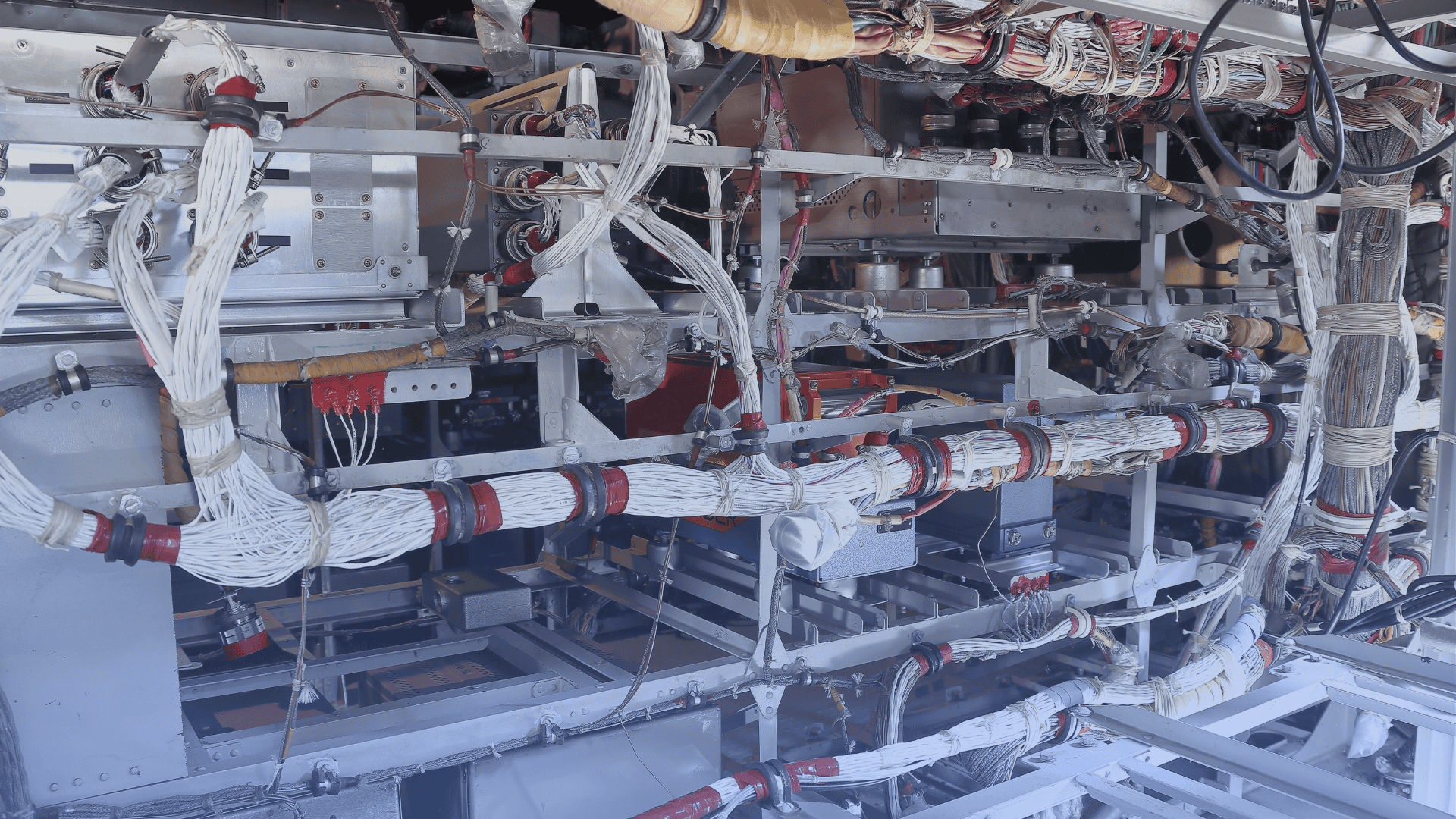
For example, modifying the routing of an electrical harness may affect:
- Assembly feasibility
- Thermal behavior
- Serviceability
- System weight
- Manufacturing sequence
Generative algorithms that treat components independently struggle to capture these system-level interactions.
Engineering design is fundamentally about system architecture.
And architecture requires structured models that explicitly represent components, relationships, and constraints.
3. AI cannot explain engineering decisions
Engineering decisions must be traceable.
In regulated industries such as aerospace, automotive, or energy systems, a design cannot simply “work.” It must be justifiable.
Design engineers need to answer questions such as:
- Why was this configuration selected?
- Which requirements does it satisfy?
- Which constraints validated the solution?
Many AI approaches operate as black boxes.
They may produce optimized results, but they struggle to explain why a specific design is correct.
For engineering teams, this lack of explainability becomes a major barrier.
Design decisions must be transparent, reviewable, and traceable throughout the development process.
This is why engineering AI increasingly combines symbolic reasoning and structured rule systems with statistical methods.
4. AI cannot replace engineering judgment
There is a persistent myth that generative design will eventually replace design engineers.
In reality, AI is changing the role of engineers rather than eliminating it.
Generative algorithms can explore thousands of possible configurations.
But selecting the right solution often involves considerations that algorithms cannot fully evaluate:
- Long-term platform strategy
- Supply chain risks
- Manufacturing scalability
- Cost trade-offs
- Maintenance complexity
These decisions require contextual understanding and strategic thinking.
Instead of replacing engineers, generative design shifts their role toward design space orchestration and decision-making.
Engineers become architects of the design exploration process rather than manual creators of individual solutions.
5. AI cannot structure the design space on its own
Perhaps the most overlooked challenge in generative engineering is the definition of the design space itself.
Before an algorithm can generate solutions, the system must be described in a structured way:
- Components and interfaces
- Parameters and variables
- Constraints and rules
- Relationships between subsystems
Without this structure, generative algorithms operate blindly.
They may produce thousands of options, but most will be irrelevant or infeasible.
This is why the success of generative engineering projects depends heavily on modeling the system correctly before applying AI.
The real bottleneck is not computational power.
It is engineering model structuring.
The real future of generative engineering
The future of AI in engineering is not fully autonomous design.
Instead, it lies in hybrid systems that combine structured engineering models with AI exploration algorithms.
In this approach:
- Engineering rules capture domain expertise
- System models define architecture and constraints
- Generative algorithms explore possible configurations
- Engineers guide decisions and evaluate trade-offs
This combination transforms generative design from a visualization tool into a true engineering decision engine.
This is precisely the philosophy behind the approach developed by Dessia Technologies.
Rather than relying solely on data-driven optimization, Dessia enables engineering teams to encode their design logic directly into computational models. Components, parameters, constraints, and engineering rules are structured within the platform, allowing AI algorithms to explore design spaces while remaining consistent with real engineering requirements.
As these structured models become richer, Dessia is also introducing an agentic architecture within the platform. In this paradigm, AI capabilities are organized as coordinated decision processes that can operate on top of structured engineering models. This architecture enables different computational processes—such as design exploration, rule verification, configuration generation, and evaluation—to be orchestrated within the engineering workflow while remaining grounded in the system model.
Once this structured foundation is in place, AI can generate, evaluate, and compare large numbers of feasible system architectures in minutes.
Within an agentic architecture, these exploration and evaluation steps can be coordinated as part of structured AI workflows interacting directly with the engineering models.
The result is not automated engineering.
It is engineering knowledge amplified by AI.
Organizations adopting this solution are not simply introducing artificial intelligence into their workflows. They are transforming their engineering expertise into scalable computational intelligence capable of accelerating design exploration, improving decision-making, and reducing costly design iterations.
Conclusion
AI-based generative design is reshaping engineering.
It allows teams to explore design spaces at a scale that was previously impossible.
But generative algorithms alone cannot capture the full complexity of engineering systems.
They cannot invent engineering knowledge, understand system architectures, justify decisions, or replace human judgment.
The real power of generative engineering emerges when AI works together with structured engineering intelligence.
Software solutions such as Dessia Technologies follow this approach by enabling engineering teams to encode system architectures, design rules, and constraints so that AI can explore feasible design configurations while remaining consistent with real engineering requirements.
Looking ahead, the emergence of agentic architectures will further extend this paradigm. By structuring AI capabilities as coordinated reasoning processes operating on engineering models, such architectures will enable more advanced automation of engineering workflows while maintaining full alignment with system constraints and domain expertise.
In this way, AI does what it does best: exploring possibilities.
And design engineers do what they have always done best — turning those possibilities into robust, industrial solutions.
In the near future, this collaboration will increasingly take the form of human engineers working alongside specialized AI agents capable of navigating complex engineering models while remaining grounded in structured design knowledge.