
AI & automation
What is synthetic engineering data? Discover how CAD, engineering rules and generated design alternatives can create new datasets for AI, design exploration and industrial engineering.
9 min reading

AI-generated 3D looks impressive until an engineer opens the file — BRep is the only format that actually works.

There's a pattern playing out across the AI world right now. Every week, someone posts a viral demo of AI generating a 3D model from a simple text prompt. It looks incredible. A part appears out of thin air. The comments fill with "the future is here."
Then a real engineer opens the file. And within thirty seconds, they close it.
Why? Because what AI generated isn't a usable part. It's a hollow shell — a visual approximation with no engineering substance behind it. You can't edit it. You can't simulate it. You can't manufacture it. You can't even measure it accurately.
This is the dirty secret of AI-generated 3D: it looks like CAD, but it isn't CAD. And the gap between "looks like" and "works like" is exactly where billions of dollars in engineering inefficiency still live.
We believe the path to closing that gap has a name: BRep-to-CAD.
Let's be clear about what engineers do all day. They don't create pretty 3D renders. They design systems that have to work — under load, under pressure, under regulatory scrutiny, and under tight deadlines.
That means every model they produce needs to be editable, parametric, constraint-driven, and compatible with the tools their organization already uses. It needs to survive a design review. It needs to export cleanly to simulation. It needs to carry enough information for a manufacturer to actually build it.
Today's AI-generated 3D models deliver none of that. They produce what the industry calls "meshes" — essentially a skin made of tiny triangles that defines a shape but contains no engineering intelligence. No feature history. No design intent. No way to make a simple dimensional change without starting over.
For engineers, this is a non-starter. It's like handing a novelist a beautiful painting of a book and asking them to edit chapter three.
This is where BRep-to-CAD changes the conversation entirely.
BRep — boundary representation — is the mathematical language that sits at the heart of every professional CAD system in the world. SolidWorks, CATIA, NX, Creo — all of them use BRep under the hood to define what a part actually is: its surfaces, edges, vertices, and the precise relationships between them.
When AI can generate geometry directly in this language, everything changes. The output isn't a visual approximation — it's a real engineering model. One that can be opened in any major CAD tool. One that can be measured, modified, simulated, and sent to production. One that speaks the same language as the rest of the engineering toolchain.
BRep-to-CAD isn't just an incremental improvement over mesh-based generation. It's the difference between AI that impresses on LinkedIn and AI that actually ships products.
Here's where the conversation gets strategic.
In the AI world, there's a well-known principle: the model architecture matters, but the training data matters more. GPT didn't win because transformers were secret — they weren't. It won because OpenAI assembled a massive, high-quality dataset to train on.
The same dynamic is about to play out in AI for engineering design. The underlying model architectures — transformers, diffusion models, sequence generators — are broadly known. Research labs around the world are working on variations of the same approaches. The algorithms themselves are not the defensible advantage.
What is defensible is access to high-quality BRep training data.
And right now, that data barely exists. The most widely used datasets in AI-for-CAD research are filled with simple shapes — basic extrusions, prismatic blocks, parts that a first-year engineering student could model in an afternoon. They bear almost no resemblance to the complex, multi-feature, constraint-rich parts that fill real industrial CAD libraries.
This is the bottleneck. And whoever solves it first gains a structural advantage that no amount of model tuning can overcome.
At Dessia, this is exactly where we see the opportunity — and it's a bet we're making with conviction.
Our platform already generates thousands of design variants for complex industrial systems: wiring harnesses, piping networks, battery architectures, mechanical assemblies. Each variant is defined by structured engineering rules and produced as real, geometrically valid output — not simplified toy geometry.
This means we're not limited to collecting data. We can generate it. At a level of complexity, diversity, and engineering realism that goes far beyond anything available in today's research benchmarks.
We're talking about parts with swept profiles, multi-surface blends, functional features, assembly interfaces, and domain-specific manufacturing constraints. The kind of geometry that actually populates industrial CAD libraries — and that current AI models have never been trained on.
When you combine that with the vast repositories of real-world CAD models that already exist across the industry, the opportunity becomes clear: the missing ingredient for AI-driven engineering isn't smarter algorithms — it's richer, more realistic training data. And that's a problem we're uniquely equipped to solve.
The teams that win won't be the ones with the best algorithm. They'll be the ones with the best data. And we intend to be in that position.
There's a reason engineers are skeptical of AI-generated designs — and it's not resistance to change. It's because their work carries real consequences.
A design error in aerospace doesn't result in a bug report. It results in a safety incident. A missed constraint in automotive doesn't cause a customer complaint. It causes a recall. Engineers are cautious because caution is their job.
This is why any serious BRep-to-CAD approach must be explainable. Not as a nice-to-have, but as a hard requirement.
Our approach is built on this principle from the ground up. We combine symbolic AI — which encodes engineering rules into structured, auditable logic — with machine learning for pattern recognition and intelligent reuse. The result: every design the platform produces can be traced back to the specific rules and constraints that created it. No black boxes. No "the AI just decided."
For industries where certification, compliance, and quality assurance are non-negotiable, this isn't a feature. It's the foundation.
While the full BRep-to-CAD vision is still taking shape, the building blocks are already delivering real results.
Our platform lets engineering teams explore over 1,000 design solutions in just 6 hours — each one valid, constraint-respecting, and ready for evaluation. Development time drops by up to 80%. Late-stage rework — the silent killer of engineering budgets — gets caught early, when it's cheap to fix.
Automated verification catches inconsistencies across drawings, 3D models, and BOMs that manual reviews routinely miss. Intelligent reuse doesn't just find parts that look similar — it finds parts that function equivalently, unlocking design heritage that was previously locked in tribal knowledge.
These are the foundations that BRep-to-CAD will be built on — and they're already proving their value in production environments across automotive, aerospace, defense, and energy.
The next wave of AI isn't just about generating content. It's about agents — autonomous systems that can plan, execute, and adapt.
In engineering, this raises a critical question: what does an AI agent actually work with?If it works with mesh approximations, it's essentially blind to engineering reality. It can't check clearances. It can't enforce tolerances. It can't validate that a part will actually fit, function, or survive manufacturing.
If it works with BRep — with real, topologically valid engineering geometry — it becomes something fundamentally more powerful. An agent that can reason about real shapes. That can verify compliance. That can generate new designs that other tools in the toolchain can actually consume.
BRep isn't just a file format. It's what makes the difference between an AI assistant that guesses and an AI agent that engineers.
This is where the industry is heading. And it's a direction we take very seriously.
You don't need to wait for the full BRep-to-CAD revolution to start preparing. The organizations that move now will be the ones best positioned when the technology matures.
Formalize what your best engineers know. The design rules, constraint logic, and manufacturing heuristics that currently live in people's heads — that's the raw material AI will need. Start capturing it in structured, computable form.
Clean up your data. AI can only work with what you give it. Investing in well-structured CAD and PLM data today pays enormous dividends when automation arrives.
Pick one high-value use case and go deep. Don't try to transform everything at once. Find the design process that's most manual, most repetitive, and most expensive to get wrong — and start there.
Demand explainability. If an AI vendor can't explain how their system produced a result, walk away. In engineering, traceability isn't a luxury. It's a requirement.
The AI-for-CAD conversation has been dominated by impressive demos that don't survive contact with real engineering workflows. It's time for a more honest conversation about what it actually takes to make AI useful for engineers.
The answer isn't better prompts. It isn't prettier meshes. It's BRep — the mathematical language that engineering already runs on — combined with training data that reflects the true complexity of industrial design.
The model architectures will keep improving for everyone. The data won't appear by itself. That's where the real race is, and that's the bet we're making.

Published on
15.04.2026
These articles may be of interest to you
AI & automation
What is synthetic engineering data? Discover how CAD, engineering rules and generated design alternatives can create new datasets for AI, design exploration and industrial engineering.
9 min reading
AI & automation
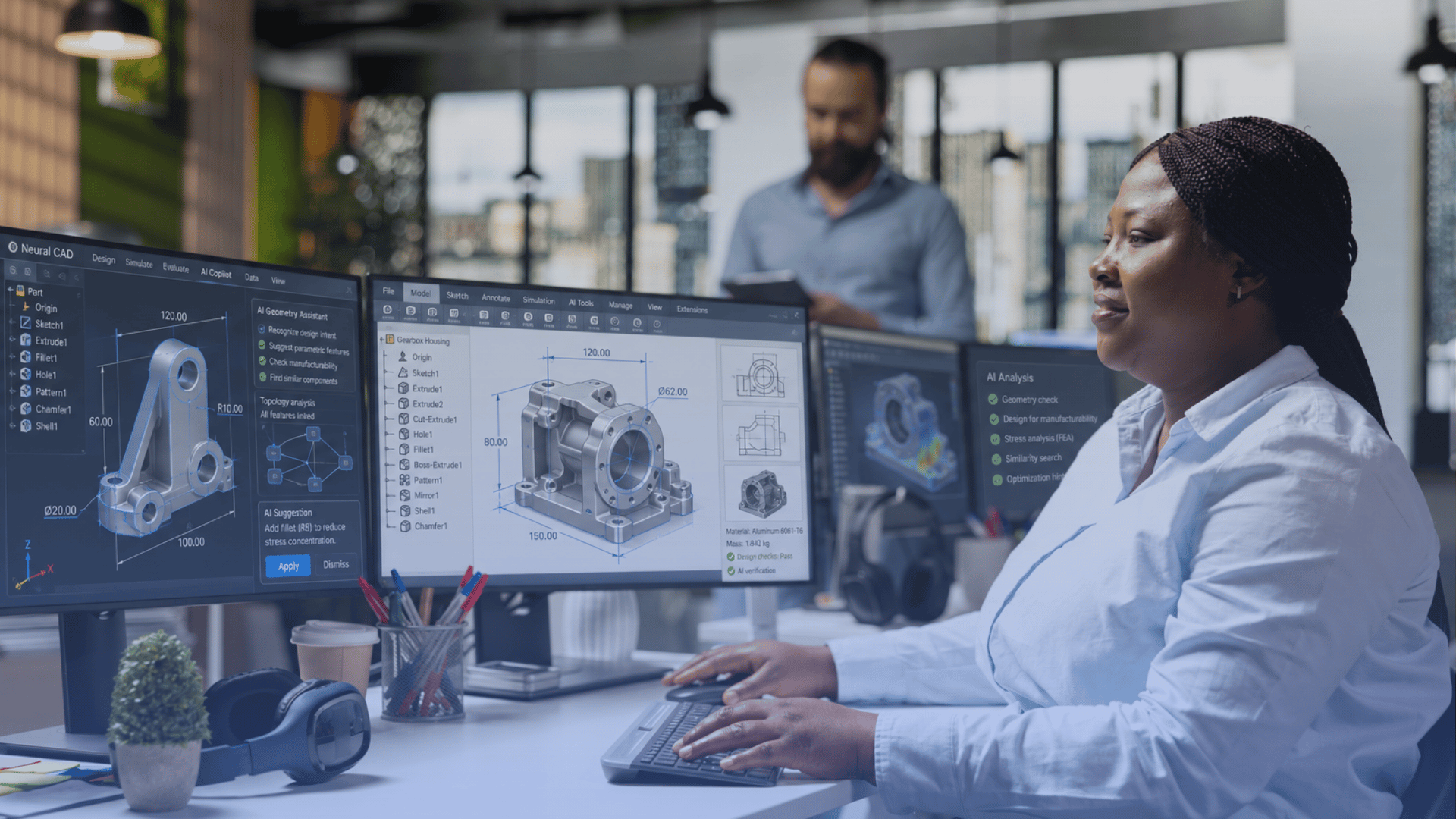
Neural CAD is pushing AI beyond images and text toward direct reasoning in engineering geometry. But the real breakthrough will come when geometric intelligence is combined with engineering rules, context and knowledge.
11 min reading

AI & automation
Aerospace and defense organizations have invested heavily in digital threads, PLM and MBSE. The next step is turning connected engineering data into decision-grade intelligence that can generate, verify and trace technical decisions directly within engineering processes.
min reading