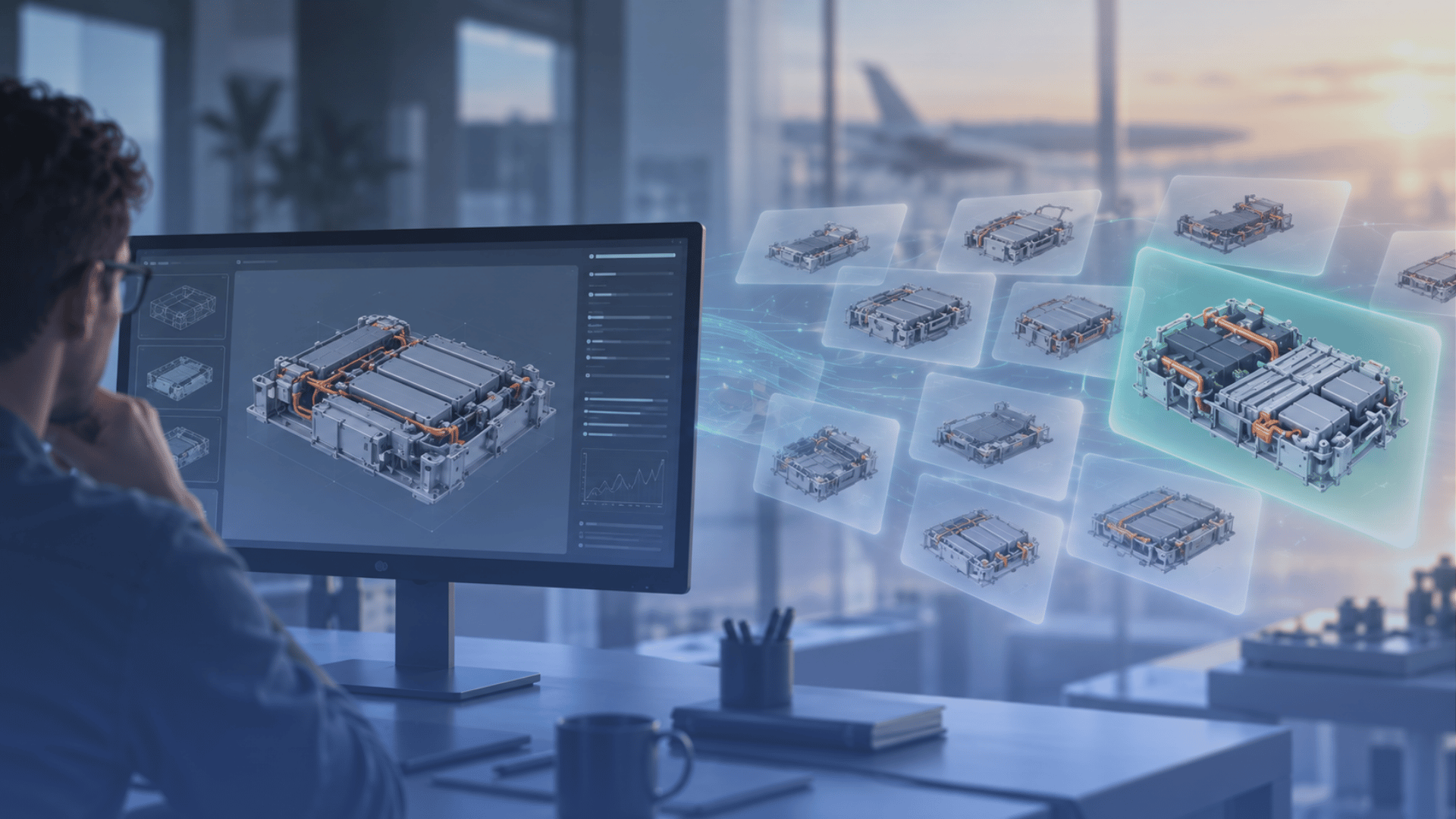
Engineering intelligence
Why CAD data alone is not enough for engineering AI—and how requirements, rules and verification turn geometry into trusted design decisions.
7 min reading

Your team already has the expertise. The problem is it's fragmented — and that's why the same mistakes keep coming back.

At some point, almost every engineering design team has lived through the same moment.
A design review is underway. The CAD looks clean, the architecture seems coherent, and weeks, sometimes months of engineering work have already been invested. Then someone in the room, usually the most experienced engineer present, quietly says: "I think we already tried this approach a few years ago. It caused issues downstream."
The room slows down immediately. Maybe they are right. Maybe they are not.
But the fact that nobody can know with certainty is already the real problem.
Because in many engineering organizations, critical know-how still depends heavily on memory, experience, and individual presence rather than structured engineering intelligence.
And this creates one of the most underestimated sources of waste in product development: repeated engineering mistakes.
Not catastrophic failures. Not headline-making incidents.
Just the constant repetition of avoidable design loops:
These problems rarely trigger major organizational discussions because they appear gradually, hidden inside normal development activity. But over time, they consume enormous amounts of engineering capacity, slow down convergence, and increase downstream risk.
And the underlying cause is often the same: Engineering organizations are structurally poor at retaining, operationalizing, and reusing their own engineering know-how.
Most companies already possess years, sometimes decades of valuable engineering expertise. Successful architectures, validated design patterns, integration strategies, manufacturing constraints, simulation feedback, interface logic, and system-level trade-offs already exist somewhere inside the organization.
The problem is that this expertise rarely exists in a reusable form.
Instead, it remains fragmented across CAD models, PLM systems, PDFs, spreadsheets, simulation reports, meeting discussions, and individual engineers’ experience. Traditional engineering systems are excellent at storing technical data, but far less effective at capturing the reasoning behind engineering decisions.
A PDM system can tell you which version of a CAD model was released. It cannot explain why one routing strategy consistently failed packaging constraints across multiple vehicle programs. A simulation report may confirm that a configuration passed validation, but not necessarily preserve the engineering trade-offs that made it viable in the first place.
As a result, engineering know-how often behaves more like temporary organizational memory than reusable industrial intelligence.
It gets generated continuously, used once, and then slowly fades into legacy data until another team unknowingly repeats the same failed approach years later.
For engineering expertise to prevent repeated mistakes, three things need to happen successfully:
The first issue is capture. Engineering expertise is usually created under development pressure — during integration discussions, validation failures, manufacturability reviews, or architecture trade-offs. Teams solve the immediate problem and move forward. Very little of this reasoning becomes formalized in a structured and reusable way.
The second issue is retrieval. Even when useful information exists somewhere, finding it at the right time remains extremely unreliable. Relevant context is spread across disconnected systems with inconsistent structures, making reuse heavily dependent on individual memory and initiative. Engineers often need to already suspect that a similar issue existed before attempting to search for it.
The final issue is application. Passive documentation competes poorly against delivery pressure. Even when engineers retrieve useful historical context, applying it consistently across active workflows remains difficult. A manufacturing constraint hidden inside an old review document is not equivalent to an engineering rule directly embedded inside the design process itself.
This distinction becomes increasingly important as products grow more complex and development cycles continue to accelerate.
This is where Dessia’s approach becomes fundamentally different.
Rather than treating engineering expertise as static documentation, Dessia enables companies to transform engineering know-how into executable engineering intelligence through reusable Dessia Libraries.
Engineering rules, validated patterns, constraints, and decision logic can be structured as Python-based engineering intelligence directly connected to automated engineering workflows. Instead of remaining passive information that engineers must manually search for and reinterpret, expertise becomes operational inside design generation, verification, and engineering decision-making processes.
When an expert engineer formalizes a manufacturability rule, a routing constraint, or a validated configuration logic, this expertise no longer depends entirely on human memory or manual review cycles. It becomes reusable across future developments and continuously exploitable at scale.
But the value goes far beyond preventing repeated mistakes.
The same engineering intelligence can also support automated design exploration. Validated parameter ranges, proven architectures, interface compatibility requirements, and manufacturing constraints can become reusable foundations for generating and evaluating multiple engineering solutions automatically.
This fundamentally changes how engineering organizations leverage experience. Instead of repeatedly rebuilding engineering reasoning from fragmented legacy data, companies progressively accumulate reusable engineering intelligence across projects.
Over time, expertise starts compounding instead of resetting.
For years, engineering reuse was primarily approached as a data management challenge. The focus was on storing CAD files, organizing legacy projects, and improving searchability across engineering databases.
But the next evolution of engineering reuse goes far beyond geometry retrieval.
The real challenge is understanding and operationalizing the engineering logic hidden inside existing engineering data: the relationships between components, the constraints that govern architectures, the manufacturability conditions behind successful products, and the validation logic accumulated across years of development.
This is precisely where AI is reshaping engineering workflows.
Not by replacing engineers, but by helping organizations structure, operationalize, and scale engineering know-how across increasingly complex product development environments.
As engineering complexity continues to grow across industries such as automotive, aerospace, defense, and industrial equipment, the companies creating the most value from engineering AI will not necessarily be those generating the largest amount of data.
They will be the ones most capable of transforming engineering expertise into reusable, operational, and continuously exploitable engineering intelligence.
The future of engineering AI is not limited to isolated automation workflows.
A new generation of agentic engineering systems is starting to emerge, capable of combining engineering knowledge, automation, and AI-driven reasoning across product development workflows.
This is also part of the direction Dessia is working on.
By combining reusable Dessia Libraries with agentic AI capabilities, engineering workflows can progressively become more intelligent, contextual, and scalable, helping teams leverage accumulated engineering know-how continuously across projects.
The objective is not replacing engineers. It is augmenting engineering expertise with systems capable of structuring, reusing, and operationalizing years of engineering knowledge at scale.
Ultimately, the companies creating the most value from engineering AI will not necessarily be those generating the most data.
They will be the ones most capable of transforming engineering know-how into reusable and executable engineering intelligence.
Engineering teams can reduce repeated design mistakes by transforming engineering know-how into reusable engineering intelligence. Dessia enables companies to structure constraints, validation logic, manufacturability rules, and proven engineering patterns inside reusable Dessia Libraries directly connected to automated workflows.
AI-powered engineering workflows can help organizations leverage existing CAD models, assemblies, interfaces, and legacy engineering data more efficiently. Dessia helps structure and operationalize the engineering logic behind existing designs rather than only retrieving geometry.
AI-powered design automation uses structured engineering intelligence, reusable rules, and automated workflows to accelerate product development activities such as design generation, engineering verification, validation, and decision-making. Dessia’s platform enables companies to build and deploy these workflows at scale.
Engineering workflows can be automated by structuring engineering constraints, validation logic, and reusable design intelligence inside programmable workflows. Dessia enables engineering teams to automate repetitive engineering tasks, support design-space exploration, and accelerate engineering validation processes.
Agentic AI for engineering refers to AI systems capable of interacting with engineering workflows, leveraging engineering knowledge, orchestrating tasks, and assisting engineers across complex product development activities. Dessia is actively working on how agentic AI can augment engineering decision-making and workflow automation.

Published on
20.08.2026
These articles may be of interest to you
Engineering intelligence
Why CAD data alone is not enough for engineering AI—and how requirements, rules and verification turn geometry into trusted design decisions.
7 min reading

Engineering intelligence
Most industrial AI pilots fail to scale because they add AI on top of fragmented engineering data (CAD, PLM, requirements, BOMs, test reports) instead of connecting that data first. An Engineering Intelligence Layer turns disconnected engineering files into a connected knowledge graph, giving AI the context it needs to produce trustworthy, traceable engineering decisions—not just plausible-sounding text.
7 min reading
Engineering intelligence
Your CAD models show what was designed. Your engineering rules explain why. Discover how Dessia's CAD-aware AI turns engineering rules into executable engineering knowledge — capturing your organization's expertise so AI can apply it automatically.
8 min reading