AI Agents in Engineering: Beyond LLMs to Autonomous Workflows
LLMs were the stepping stone. AI agents are the destination—autonomous systems that plan, execute, and validate engineering workflows at a scale no human team can match.
Engineering is being reorganized from the inside out
The transformation happening in engineering workflows right now is not about better tools. It is about a different category of system — one that doesn't assist engineers in executing tasks, but executes entire workflows on their behalf, autonomously and at a scale no human team can match.
Large language models accelerated this shift. But LLMs are not the destination. They are a stepping stone. The real disruption is the rise of AI agents: systems capable of planning, executing, validating, and iterating across multi-step engineering workflows without continuous human direction. If your organization is still thinking about AI through the lens of copilots, you are already a step behind.
What Language models changed, and what they didn't
LLMs transformed how engineers interact with knowledge: querying documentation conversationally, generating code, summarizing simulation outputs. These are real gains. But LLMs were designed for language, and engineering is not primarily a language problem.
The moment you move from querying a model to executing engineering work, you hit data that language systems were never built to handle reliably: geometry, constraints, tolerances, assembly relationships. A CAD environment is not a text corpus. A PLM system is a living record of design decisions that must remain consistent at all times. LLMs approximate and generalize — and in engineering, an invisible constraint violation is precisely the kind of error that surfaces after manufacture.
That is the gap AI agents are designed to close.
What AI Agents in engineering actually are
An AI agent, in the engineering context, is a system that pursues an objective autonomously: planning a sequence of actions, executing them using available tools and data, validating outputs against defined constraints, and adapting based on results — without human direction at each step.
Four capabilities define a genuine engineering agent:
Planning: given an objective, the agent constructs the steps to achieve it without waiting to be told what to do next.
Execution: it calls tools, queries geometry, applies constraint logic, and writes structured outputs on real engineering data.
Validation: it checks outputs against applicable rules at each step — interference, tolerance violations, compliance failures are detected by the agent, not a downstream reviewer.
Iteration: if an output doesn't satisfy the objective, the agent revises through goal-directed iteration until it converges.
This is what engineering teams are beginning to call agentic workflows, end-to-end processes initiated by human intent and executed autonomously by AI systems operating on structured engineering knowledge.
From Human-Triggered Steps to Autonomous Execution
From tools to systems, and from one agent to many
The history of engineering software is a history of increasingly powerful tools. Each generation made engineers more capable without changing the fundamental model: a human at the center, manually orchestrating every step. That model has a ceiling, and as product complexity accelerates, the coordination overhead grows faster than any team can absorb.
The shift from tools to systems is the structural response: an orchestration layer that receives an engineering objective, decomposes it into executable subtasks, routes each to the right model or tool, validates results, and synthesizes a coherent output. And the most capable implementations don't rely on a single agent, they rely on networks of specialized agents working in parallel.
In practice: a design agent generates candidate configurations. A validation agent checks each against engineering rules. A cost agent evaluates manufacturability. An optimization agent synthesizes all three and surfaces the best trade-offs across performance, compliance, and cost — simultaneously, not sequentially. Full design space exploration, not intuition-driven sampling, becomes tractable.
Four specialized agents, one optimal output
Structured knowledge: The foundation that makes it reliable
Most AI initiatives in engineering fail here, and the failure is invisible until it's expensive.
Agents are only as reliable as the knowledge they operate on. If that knowledge is unstructured, buried in PDFs, approximated by a generative model, the agents built on top of it will be unreliable in ways that are hard to predict and dangerous to accept. Structured engineering knowledge means constraints as executable logic, parameters with defined types and dependencies, rules that can be applied programmatically and verified deterministically.
Without this foundation, you don't have an autonomous engineering system. You have a probabilistic approximation dressed up as one. And beyond the technical requirement, structured knowledge is a strategic asset: it scales, it outlasts individuals, and it applies consistently across every team and project.
Dessia's Lagrangia: Solving the knowledge structuring bottleneck
Dessia is a platform dedicated to structuring and reusing engineering knowledge, enabling teams to capture domain expertise as workflows, algorithms, and executable agents — transforming tacit knowledge into deployable infrastructure.
The bottleneck has always been the cost of that structuring. Creating an agent for a new engineering scope traditionally required months of developer effort: extracting know-how from domain experts, translating it into executable logic, assembling it into functional workflows. That overhead has deprioritized automation across entire domains of engineering work, not because it wasn't valuable, but because the ROI was uncertain.
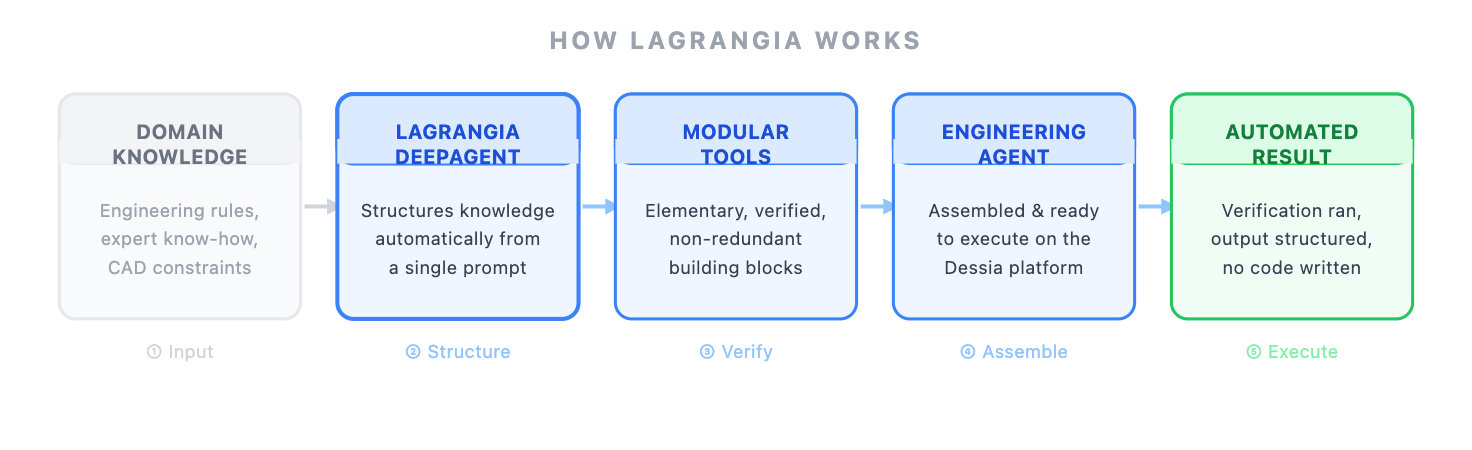
Lagrangia is Dessia's answer. It is a DeepAgent — an AI model built on an agentic architecture — designed to automate knowledge structuring and agent creation itself. Given a domain knowledge base, Lagrangia autonomously decomposes it into modular, non-redundant tools; verifies their consistency with the existing library; and assembles them into complete engineering agents ready to execute on the Dessia platform — from a prompt, without manual developer intervention.
In its current version, Lagrangia specializes in data science applied to 3D CAD: shape search, pattern recognition, distance calculation, and on-the-fly generation of ephemeral geometry for automated verifications. A concrete example: automated screwdriver accessibility verification on bolted assemblies — detecting screws, generating clearance volumes, checking interference, producing a structured compliance result, without a single line of code written for that specific workflow.
From domain knowledge to deployed agent
When knowledge structuring no longer requires months of effort, the ROI question shifts from can we afford to digitalize this scope? to which scope do we automate next?
What changes, and what comes next?
When validation runs autonomously and agents execute in parallel, design cycle times compress structurally, not incrementally. When engineering knowledge is encoded and reusable, quality becomes consistent regardless of team or project. When agents explore the design space systematically, better solutions surface — ones no one had the bandwidth to find manually.
The trajectory of this shift points toward a specific future: engineering teams whose primary role is not to execute design workflows, but to define the objectives and constraints that autonomous systems optimize against. Engineers as system architects. AI agents as the execution layer.
The organizations that invest now in the structured knowledge infrastructure that makes this reliable will not simply be faster. They will be operating at a level of capability that tools-focused competitors cannot easily replicate.
The future of engineering is not AI-assisted. It is AI-orchestrated.
Neural CAD is pushing AI beyond images and text toward direct reasoning in engineering geometry. But the real breakthrough will come when geometric intelligence is combined with engineering rules, context and knowledge.
Aerospace and defense organizations have invested heavily in digital threads, PLM and MBSE. The next step is turning connected engineering data into decision-grade intelligence that can generate, verify and trace technical decisions directly within engineering processes.
CAD is no longer just geometry. Discover how Dessia's CAD-aware AI transforms native CAD models into reusable engineering intelligence by connecting geometry with design intent, requirements, and engineering knowledge.