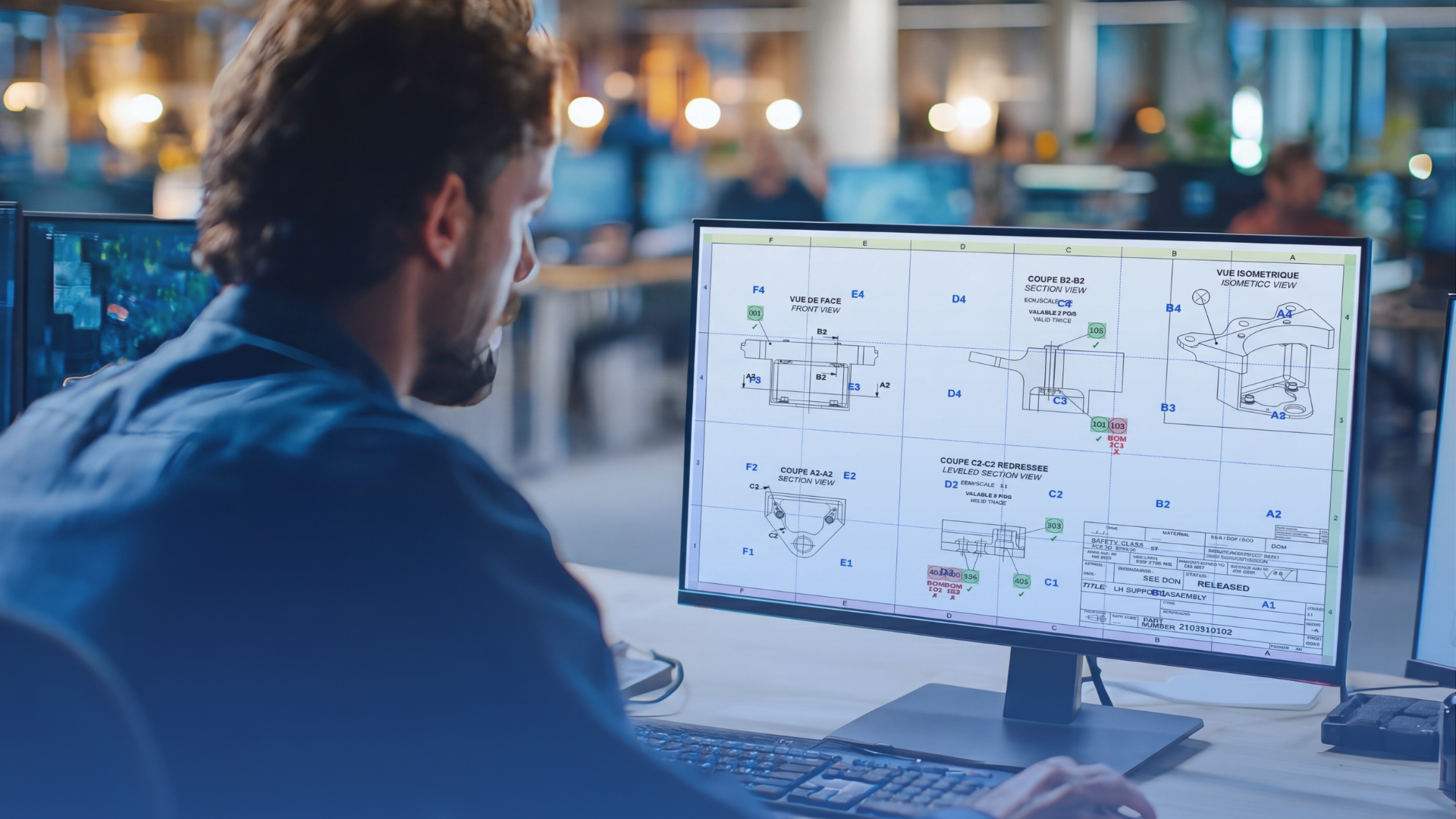
AI-driven wiring harness routing on a powertrain environment
Harness routing is still done manually in CAD. What if AI could generate constraint-compliant paths in minutes? Explore this real engineering case study.
Introduction: The rise of AI-driven design workflows
Engineering design teams designing modern products face an increasingly complex challenge: integrating electrical systems inside dense mechanical architectures while respecting hundreds of design constraints.
In industries such as automotive, aerospace, robotics, and industrial machinery, wiring harnesses must be routed through tightly packed assemblies containing structural components, thermal zones, moving mechanisms, and restricted spaces. Modern vehicles alone can contain several kilometers of wiring connecting thousands of electrical signals across the architecture.
Traditionally, harness routing is performed manually in CAD environments. Engineers iteratively define routing paths, verify clearances, adjust curvature, and ensure manufacturability.
This approach often leads to long engineering cycles, limited exploration of design alternatives, and significant manual effort.
What is often overlooked is the scale of the problem. In the automotive industry alone, hundreds of engineers can work on harness design across OEMs and suppliers, with dozens of designers dedicated specifically to routing and system integration on a single vehicle program. Despite this scale, harness routing remains one of the last major engineering tasks still performed largely manually in CAD environments.
AI-driven generative engineering introduces a different paradigm. Instead of manually defining routing paths, designers define system inputs, constraints, and routing rules, allowing algorithms to explore the design space and generate feasible routing solutions automatically.
This case study illustrates how such an approach can be applied to wiring harness routing within a complex powertrain environment using an AI-App built within Dessia’s platform.
Case study: AI-driven wiring harness routing on an powertrain environment
To illustrate how generative engineering can automate routing tasks, we consider the example of wiring harness integration on a powertrain assembly.
The goal is to automatically generate feasible harness routing paths between connectors while respecting geometric constraints, installation rules, and surrounding CAD geometry.
Input data
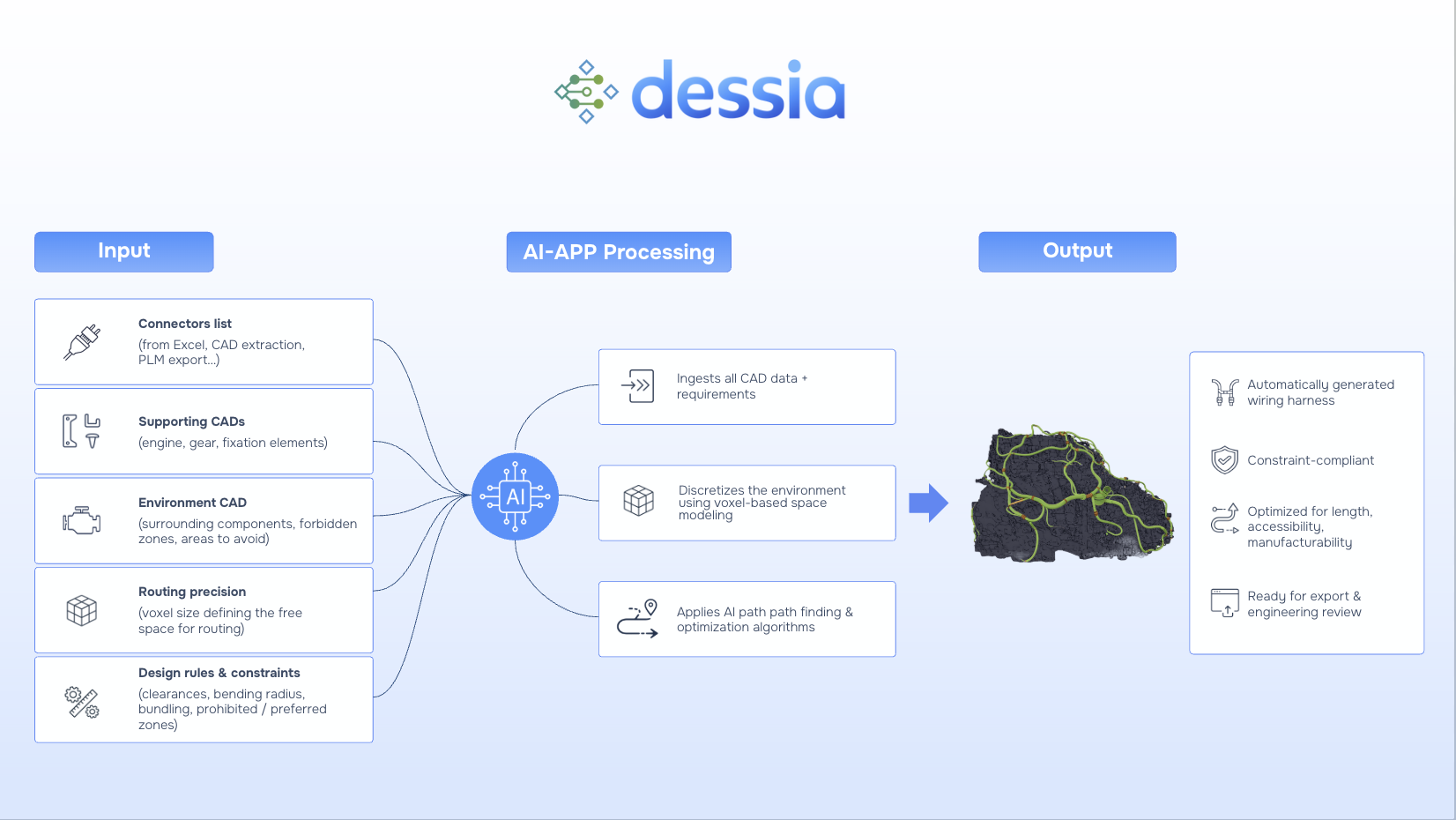
The process begins with engineering inputs describing the system architecture and its constraints. Typical inputs include:
- Connector lists, extracted from Excel, CAD models, or PLM systems
- Supporting CAD geometries, such as powertrain components, brackets, and fixation elements
- Environment CAD, representing surrounding components and restricted areas
- Routing precision parameters, defining voxel resolution for routing space
- Design rules and engineering constraints, including bending radius, clearances, and preferred routing zones
These inputs capture both the product geometry and the engineering knowledge governing installation.
AI processing
Once the inputs are defined, the AI application processes the routing problem in several steps.
First, it ingests CAD data and engineering requirements to build a structured model of the installation environment.
The system then discretizes the CAD environment into a voxel-based space, allowing the routing algorithm to identify free routing regions and obstacles.
Finally, AI-driven pathfinding and optimization algorithms explore the available routing space to generate feasible harness paths that respect all defined constraints.
Output
The result is an automatically generated wiring harness routing solution that:
- Respects engineering constraints
- Avoids prohibited zones and obstacles
- Is optimized for routing length and accessibility
- Can be exported directly for engineering review
This approach allows engineers to quickly generate and evaluate routing solutions that would otherwise require significant manual effort.
Why wiring harness design is one of the hardest problems in system integration
Wiring harness design is a complex system integration problem at the intersection of mechanical architecture, electrical systems, and manufacturing constraints.
A single wiring route must simultaneously satisfy multiple engineering requirements, including:
- Clearance from surrounding components
- Minimum bending radius for cables
- Attachment spacing rules
- Manufacturability constraints
- Accessibility for assembly and maintenance
Harnesses must also navigate dense architectures such as powertrain systems, chassis structures, aircraft systems, or industrial machines.
In large engineering programs, routing complexity quickly scales to hundreds or thousands of connections. In the automotive industry, harness engineering alone can involve large teams across OEMs and suppliers responsible for electrical architecture, schematics, routing, and validation.
Without automation, designers must manually evaluate routing paths inside CAD environments, which limits design exploration and system optimization.
AI-driven design automation allows designers to generate and evaluate routing solutions computationally while respecting engineering constraints.
AI-driven routing fundamentals
AI-driven routing operates inside a 3D CAD-derived environment representing the product architecture.
Routing algorithms connect ports while navigating surrounding components and respecting spatial constraints defined by engineers.
Hard constraints: prohibited zones
Certain areas cannot be crossed under any circumstance, including:
- Moving mechanical components
- High-temperature zones
- Safety-critical areas
Soft constraints: areas to avoid
Some regions are not forbidden but should be avoided whenever possible.
If routing crosses these areas, the algorithm increases the routing cost, encouraging alternative paths.
Preferred routing zones
Engineers may also define preferred routing corridors where cables are easier to install and maintain.
These zones guide the algorithm toward desirable integration paths while preserving flexibility.
Engineering design rules governing harness routing
Beyond spatial constraints, harness routing must follow strict engineering design rules to ensure feasibility and manufacturability.
Geometric constraints
These rules define cable behavior along the routing path, including:
- Minimum bending radius
- Minimum straight length between bends
- Connector alignment angles
- Smooth curvature continuity
Spatial integration constraints
Harnesses must integrate safely within surrounding CAD geometry, requiring:
- Minimum clearance from nearby structures
- Spacing between parallel harness routes
- Regularly spaced attachment points
- Restricted routing within prohibited zones
Route organization
In real systems, electrical connections are often grouped into bundles sharing common routing corridors.
Routing rules therefore also define bundle organization and shared paths, enabling algorithms to generate realistic harness architectures.
From path generation to path optimization
AI-driven routing typically involves two computational stages.
Path generation
The CAD environment is first discretized into a voxel-based spatial model representing available routing space.
AI pathfinding algorithms explore this space to generate candidate routes connecting ports while avoiding obstacles and prohibited zones.
Path optimization
Selected candidate paths are then refined using optimization algorithms that evaluate criteria such as:
- Routing length
- Curvature smoothness
- Compliance with design rules
- Attachment placement
- Accessibility for assembly
The result is a constraint-compliant routing solution ready for engineering design review and CAD integration.
AI-driven harness routing workflow
AI-powered harness design integrates several engineering data sources into a generative engineering workflow.
Typical inputs include:
- Connector lists from PLM systems or engineering spreadsheets
- CAD assemblies describing the product environment
- Surrounding components and obstacles
- Engineering design rules and routing constraints
- Voxel resolution parameters defining routing precision
The system then:
- Converts the CAD environment into a voxel-based routing space
- Generates candidate routing paths using AI pathfinding algorithms
- Optimizes the paths to satisfy engineering rules and constraints
The final output is a constraint-compliant harness routing design ready for CAD export and engineering validation.
Business impact of AI-driven design automation
AI-driven routing automation delivers significant benefits for engineering organizations.
Routing tasks that previously required extensive manual CAD work can now be generated computationally within minutes. This is particularly important in industries such as automotive, where vehicles contain kilometers of wiring and thousands of electrical connections.
AI also enables engineers to evaluate multiple routing alternatives automatically, improving system integration decisions.
By encoding routing rules directly into computational models, companies can standardize engineering knowledge across programs and reuse design logic across projects.
Finally, design automation reduces repetitive CAD work, allowing engineers to focus on system architecture, integration strategy, and engineering innovation.
Key takeaways
This case study illustrates how AI-driven generative design can automate wiring harness routing within a complex powertrain environment. By combining CAD geometry, engineering constraints, and optimization algorithms, feasible routing solutions can be generated automatically while respecting installation rules such as clearances, bending radius, and accessibility.
Instead of manually defining routing paths in CAD, designers can define system inputs and constraints, allowing algorithms to explore and optimize routing configurations computationally.
Although demonstrated here for wiring harness integration on a powertrain architecture, the same generative design approach can be applied to other constrained installation problems such as piping networks, fluid systems, and HVAC routing in complex products.
Frequently asked questions
What is AI-driven wiring harness routing?
AI-driven wiring harness routing uses algorithms to generate feasible cable paths inside a CAD assembly while respecting engineering constraints such as clearance, bending radius, and installation rules. In this case study, an AI application developed with Dessia’s technology automatically computes harness routing inside a dense powertrain environment.
How does AI automate harness routing?
Engineers define connectors, surrounding components, and routing constraints. The AI application then computes routing paths that satisfy geometric and installation rules, allowing engineers to generate feasible routing solutions without manually drawing cable paths in CAD.
Why is generative engineering useful for harness design?
Harness routing involves multiple constraints such as geometry, accessibility, and manufacturability. Generative engineering allows algorithms to explore routing possibilities automatically while remaining compliant with engineering rules, helping teams evaluate integration solutions faster.
Can the same approach be used for other systems?
Yes. The same generative engineering approach used in this case study can also automate routing for other constrained systems such as piping networks, fluid circuits, HVAC installations, or cable systems in aerospace, automotive, and industrial machinery.
Keep exploring - Discover more case studies
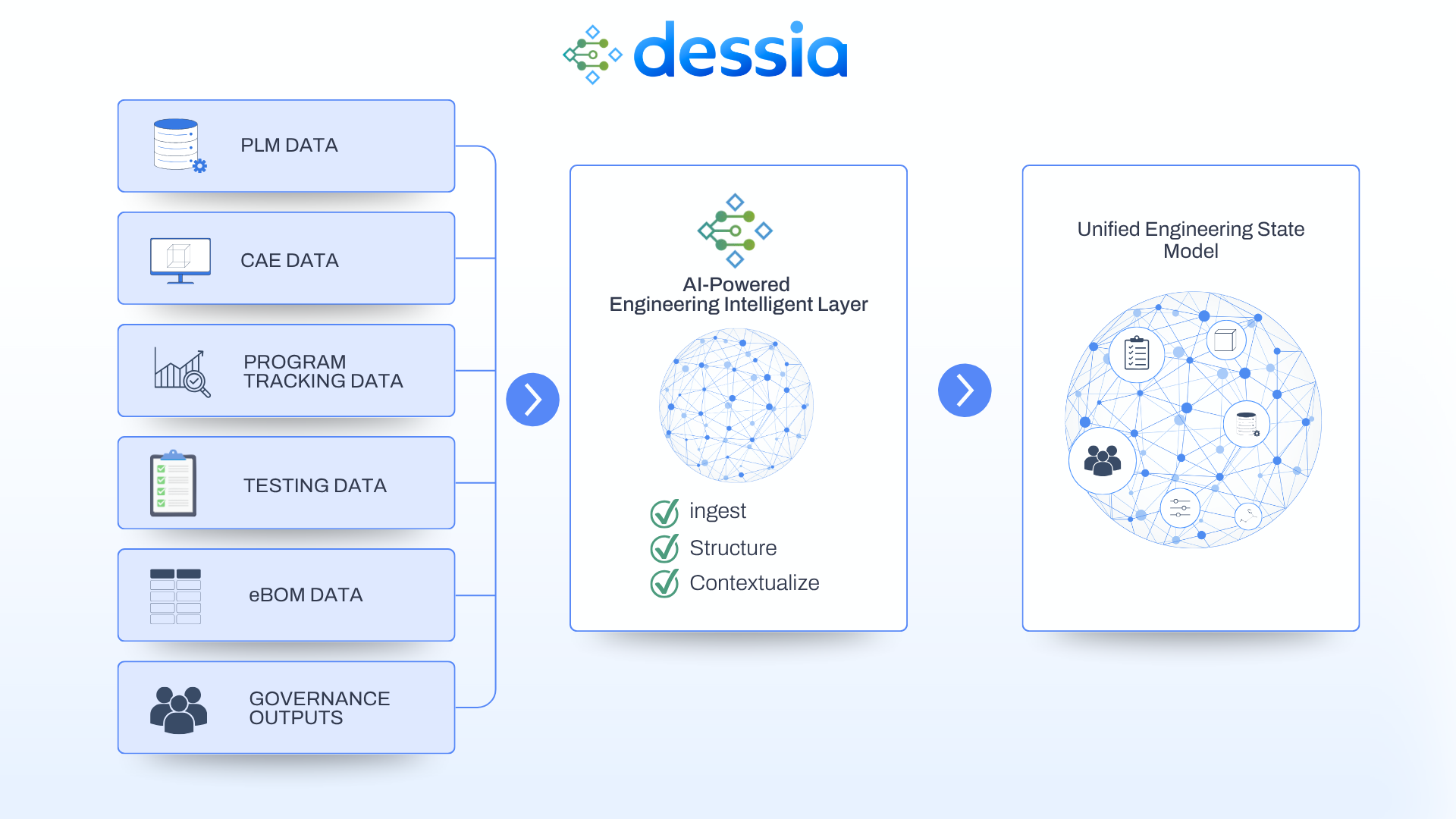
AI for Knowledge Reuse
9
min reading