AI-driven 3D product cost estimation
Dessia’s AI libraries can be leveraged to develop custom AI-Apps for 3D product cost estimation, bringing cost insight earlier into engineering workflows directly from CAD assemblies and historical costing data.
Cost is one of the most critical constraints in product development—yet it is still too often treated as a checkpoint at the end of design. Teams build a concept, refine the architecture, converge on interfaces, and only then realize that the cost baseline does not hold. When that happens, decisions must be revisited: parts are reworked, assemblies are simplified, suppliers are reconsidered, and schedules slip.
The issue is not a lack of expertise. It is timing. Most organizations do not have a reliable way to translate early 3D design choices into cost expectations fast enough to guide engineering decisions.
This case study describes how with Dessia librairies and software framework, customized AI-driven product cost estimation App can be developed to change that dynamic by bringing cost insight closer to where design decisions are made—directly from 3D CAD assemblies and historical manual costing data.
Why early-stage cost estimation breaks down in engineering programs
In early stages, design engineers don’t evaluate one design. They evaluate options to meet requirements: different ways to split an assembly, different interfaces, different design rules, different component strategies. Those are not cosmetic differences; they can have large influence on product cost.
But early-stage costing typically relies on a mix of spreadsheets, expert judgement, and past references that are hard to reuse consistently. Two teams may estimate the same assembly differently. Two similar designs may end up with very different costing outcomes because the reasoning was not grounded in a comparable reference.
And when cost feedback arrives late, it is often too blunt to be actionable. It tells you the result—without helping you understand which design choices led there, or what alternative would have been safer.
What engineering teams need is not just a number. They need a way to compare, simulate, and decide—while design is still flexible.
Approach: Geometry-aware cost prediction using historical costing data with AI
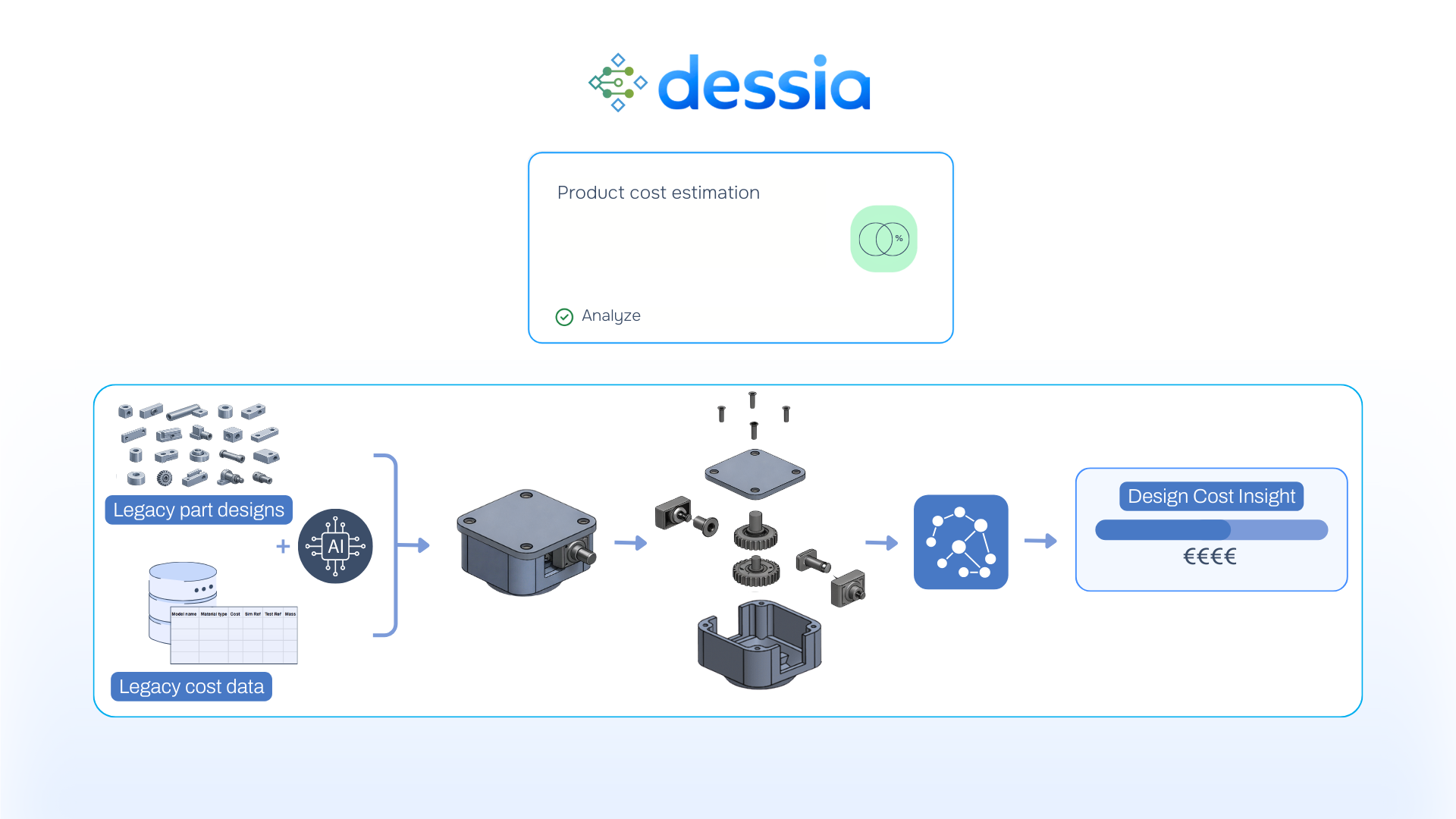
With the AI-Driven 3D cost estimation, you import a 3D sub-assembly and the system analyses it as a structured product—how it is built, how elements relate, and where complexity concentrates. Then it uses your organization’s historical manual costing data as learning material to estimate what a similar design typically costs.
Concretely, the workflow starts by augmenting the 3D assembly with manufacturing-relevant features extracted from geometry and structured for downstream AI-models: exhaustive dimensional signals (diameters, radii, chamfers, lengths beyond the bounding box), multi-dimensional geometric signatures (including decomposition-based representations such as SVD (Singular Value Decomposition)), and operation-aware complexity indicators engineered as ML-ready proxies for manufacturability (For ex. machining-sensitive surfaces and material volume proxies).
These signals are then used for pattern recognition and cost-driver identification: the model isolates the principal geometric patterns that explain cost variance, ranks feature importance, and highlights which drivers correlate most strongly with the final component or sub-assembly cost.
On the modeling side, the approach typically combines an interpretable linear regression baseline with multi-strategy learning (For ex. clustering into cost-homogeneous families with per-cluster regressors, then ensemble methods to capture non-linear relationships) to select the best-performing predictor through validation.
Alongside the estimate, the output can include cost-driver breakdowns and confidence/uncertainty metrics—so teams don’t just get a number, they get decision-grade context and a clear roadmap to improve accuracy over time.
The result is a cost prediction that is not disconnected from engineering reality. It is based on patterns learned from real 3D product design: what tended to cost more, what tended to cost less, and how those outcomes correlated with design choices.
Because the output is generated from the 3D assembly itself, engineers can use it early—before the downstream costing cycle, before supplier RFQs, and before detailed industrialization decisions are locked.
Cost estimation use cases across the design workflow
In practice, the AI-App supports the moments where design and cost decisions collide:
1) Early concept screening
Engineers can test several architecture options quickly and identify which ones are likely to drift from cost expectations. This prevents teams from investing weeks into a direction that will later be rejected on cost.
2) Variant and configuration comparison
When products exist in many versions, small design differences can create cost surprises. The AI-App helps teams compare variants earlier and assess cost impact before committing to a configuration strategy.
3) Design trade-off simulation
Teams often want to explore “what-if” questions: what if the assembly is simplified? what if interfaces are changed? what if the structure is reorganized? The AI-App enables earlier cost simulation to guide those trade-offs—without waiting for a full costing exercise.
4) Reuse with cost awareness
Many organizations aim to reuse proven designs. The AI-App helps teams connect new sub-assemblies to cost-relevant historical references—so reuse decisions are informed not only by geometry similarity, but by cost behavior observed on past programs.
5) Lifecycle and after-sales costing support
Cost questions do not stop once a design is released. During production life and after-sales, teams still face decisions that impact cost: redesigning a spare part, adapting a sub-assembly to a supplier change, responding to obsolescence, or evaluating a retrofit. The AI-App can be configured to support these workflows by using historical costing references to benchmark new or modified designs, estimate expected cost ranges, and compare alternatives—helping teams make faster, more consistent decisions across the product lifecycle.
The impact: earlier alignment, less rework, more predictable outcomes
Organizations use this approach to improve cost predictability across programs by connecting historical costing knowledge directly to 3D assemblies. In practice, it drives impact in three ways:
- Earlier alignment on cost targets
Teams get cost feedback while design choices are still flexible, so cost becomes a steering input—not a late checkpoint.
- Fewer late-stage redesign loops
By identifying cost drift sooner, engineers can adjust architecture and complexity before changes become expensive and disruptive.
- Faster convergence across variants and lifecycle decisions
A consistent reference baseline helps teams compare alternatives, justify reuse decisions, and maintain control as configurations multiply.
Keep exploring - Discover more case studies
AI for Knowledge Reuse
9
min reading