AI-drawing verification: Why manual checks are not enough
From BOM integrity to safety classification — Dessia's AI verifies every 2D drawing automatically, at every release, with full traceability on every finding.
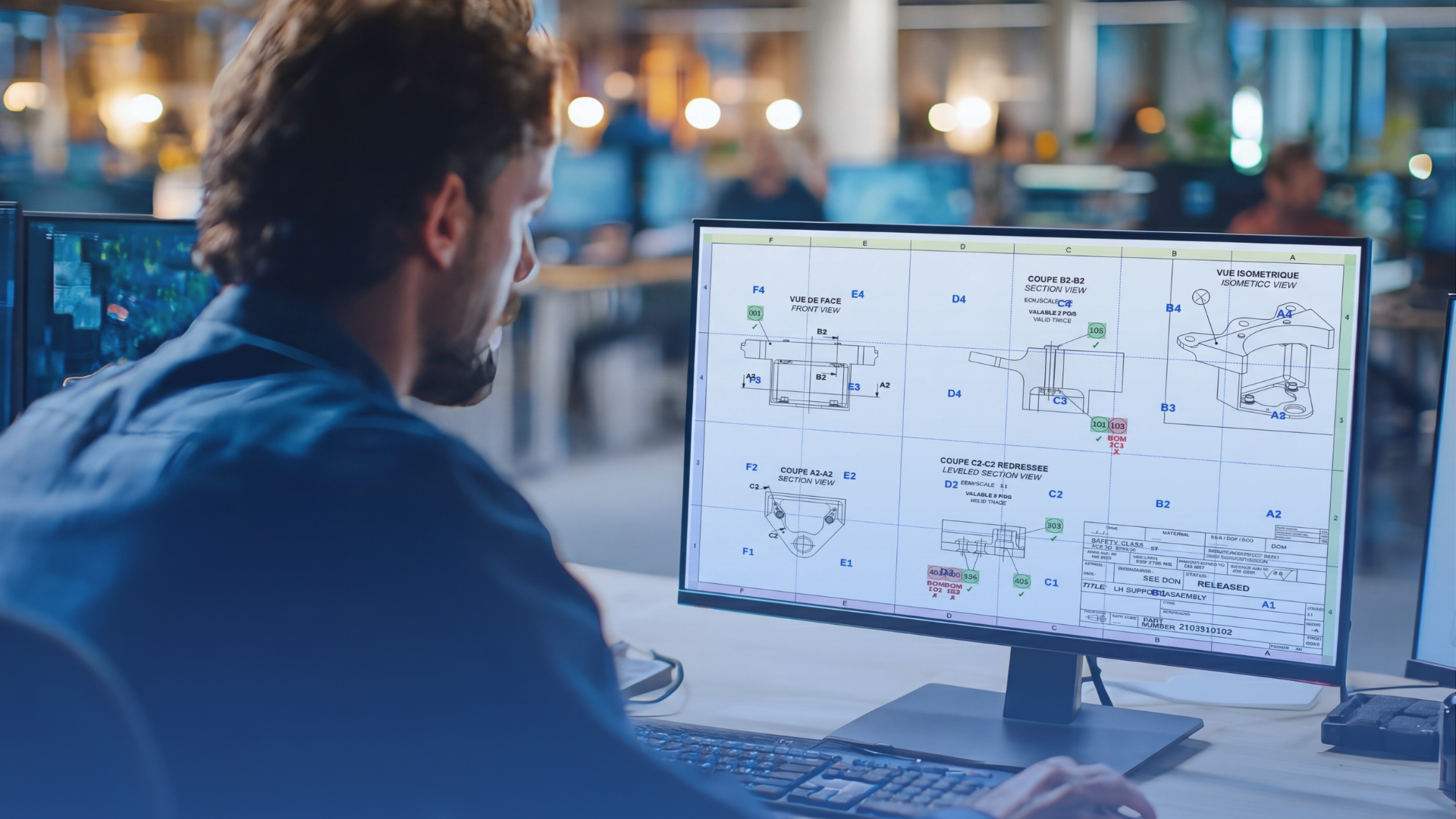
In aerospace, automotive, energy, and industrial equipment — anywhere drawings drive production — the same problem repeats itself. A balloon appears in the wrong grid zone. A BOM quantity doesn't match the drawing. A safety classification contradicts the QA workflow. The drawing passed review. Nobody caught it. And by the time it surfaces, it's a rework cycle, a procurement error, or a nonconformance report.
This is the use case Dessia library was built for. Dessia's AI detects what manual review misses — running exhaustive, automated, cross-source verification of every 2D drawing, at every release, with full traceability on every check. Here's exactly what that covers, and why it changes everything about how engineering teams release with confidence.
The problem
The gap your review process isn't catching
You've invested in CAD. You're running PLM. Your simulation pipeline is solid. And yet — drawings with inconsistent BOM references, mismatched safety classifications, and missing section views still make it past release.
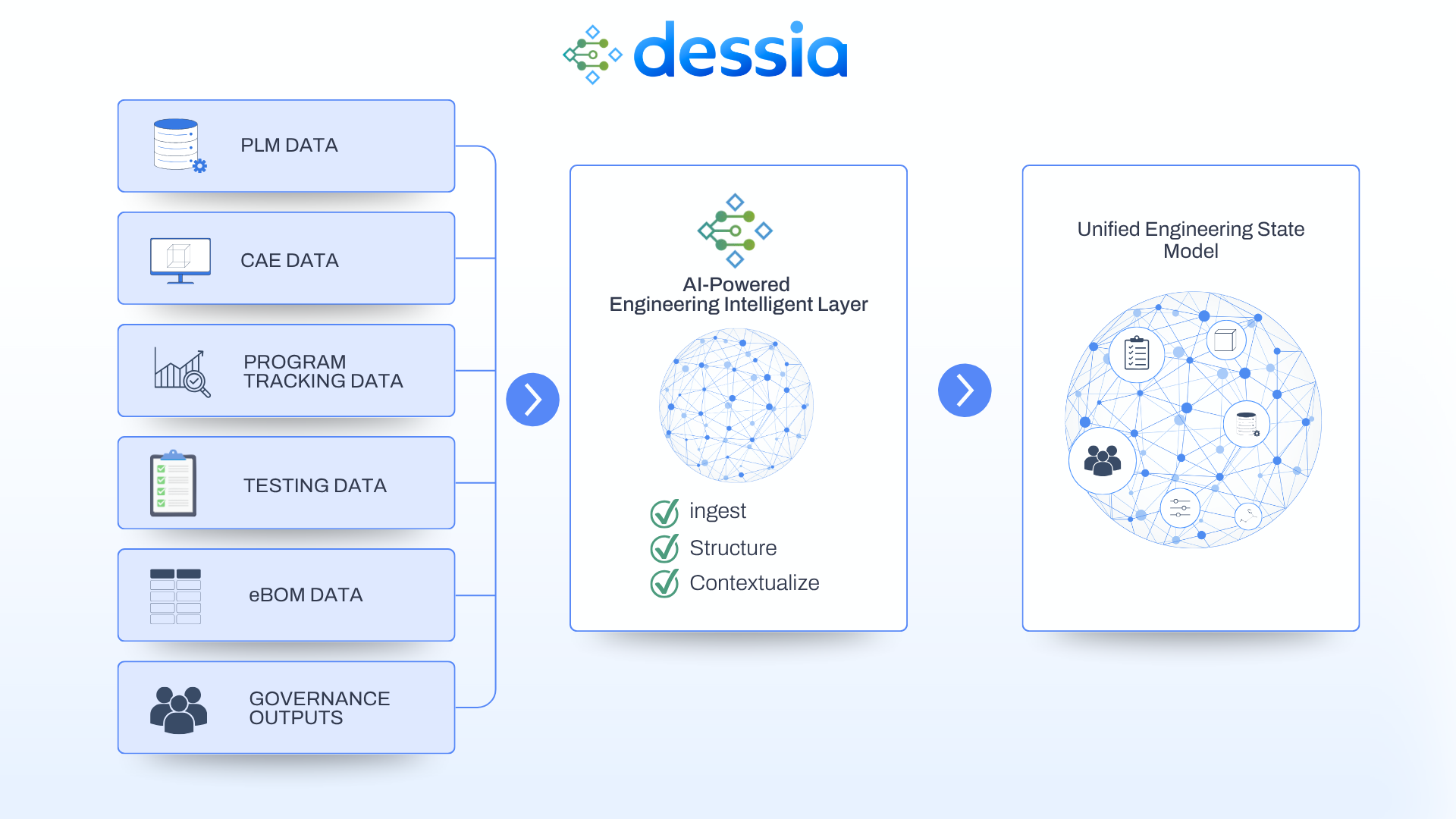
This isn't a tooling problem. It's a structural one. A technical drawing is the convergence point of at least four independent data sources:
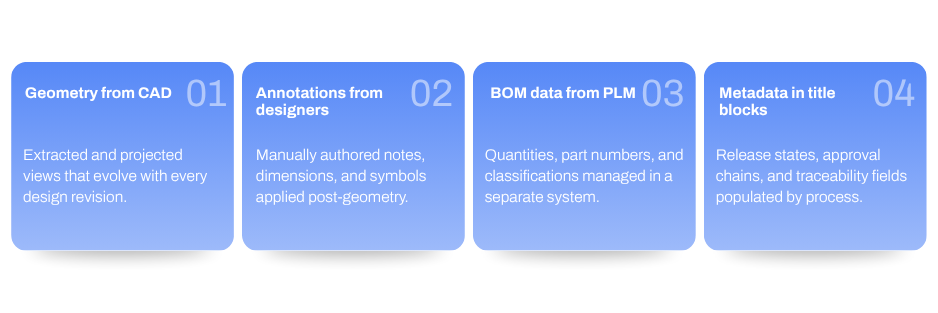
Drift is the default state. The question isn't whether inconsistencies will appear — it's whether they'll be caught before they reach the shop floor, the procurement team, or the certification audit.
The drawings that cause the most damage in production aren't the ones with obvious errors. They're the ones that look fine until someone tries to build from them.
The limitation
Why manual review can't solve this
Manual review is not the problem, it's the limit. Engineers bring judgment that no system can replicate. But as a quality gate for cross-source consistency, it has hard limits that get worse as complexity scales.
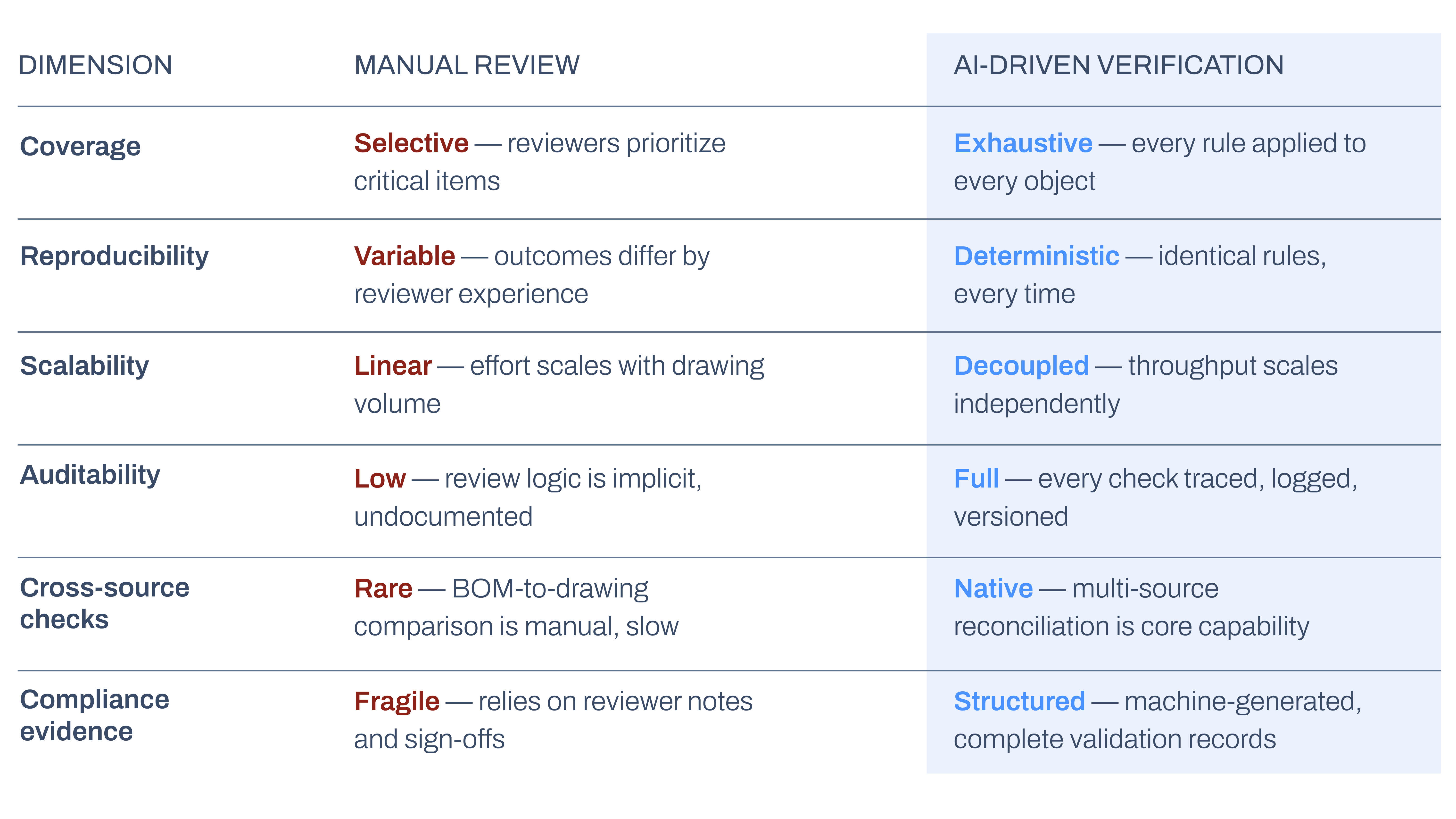
The result is predictable: manual review reduces the probability of obvious errors. It offers no guarantee against the systemic inconsistencies that require cross-source reasoning to detect — and those are exactly the ones that reach production unnoticed.
The capability
What Dessia’s AI-powered drawing verification & validation actually does
Dessia doesn’t simply accelerate the review process. It replaces the part that was never truly reliable to begin with: exhaustive, rule-based reconciliation across multiple sources, applied to every element of every drawing at the point of release.
Here are some examples of what Dessia covers in practice:
BOM ↔ Drawing localization
Every part on a drawing is identified by a numbered balloon, placed at a specific grid zone on the sheet. The BOM declares exactly where that balloon should be.
When the two don't match, whoever reads the drawing downstream has to search manually, or picks the wrong part.
Dessia cross-references every BOM row against the actual balloon position and flags every mismatch before release.

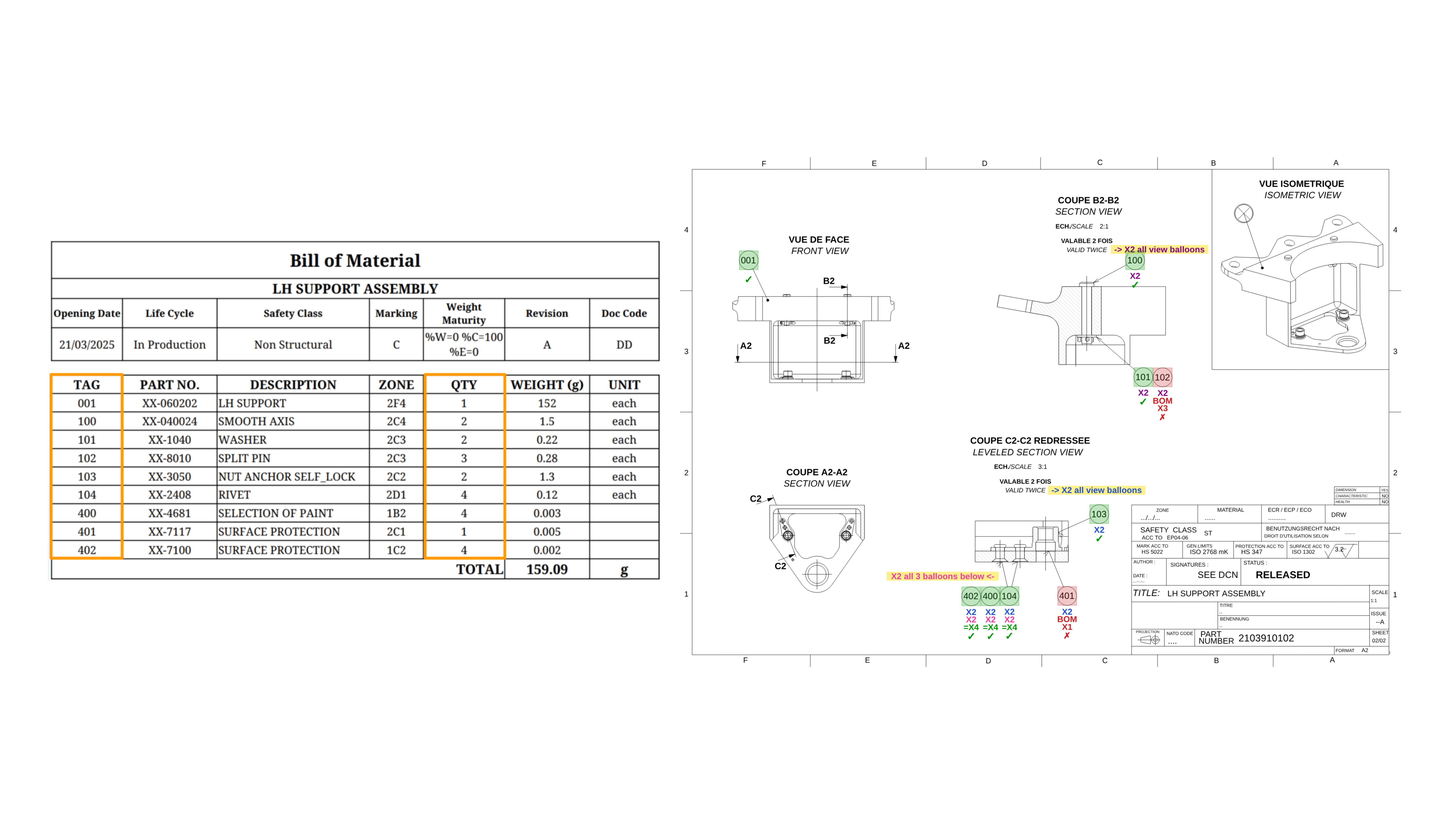
Quantity integrity and supply chain protection
Quantity on a drawing isn't just counting balloons. The real number depends on multipliers written next to the balloon, views that apply more than once, and how many leader lines point to the same part.
A drawing showing four instances while the BOM calls for two means the assembly runs short. An over-declared BOM inflates costs.
Dessia reconstructs the true quantity for every part and validates it against the BOM — before it reaches production.
Safety classification alignment
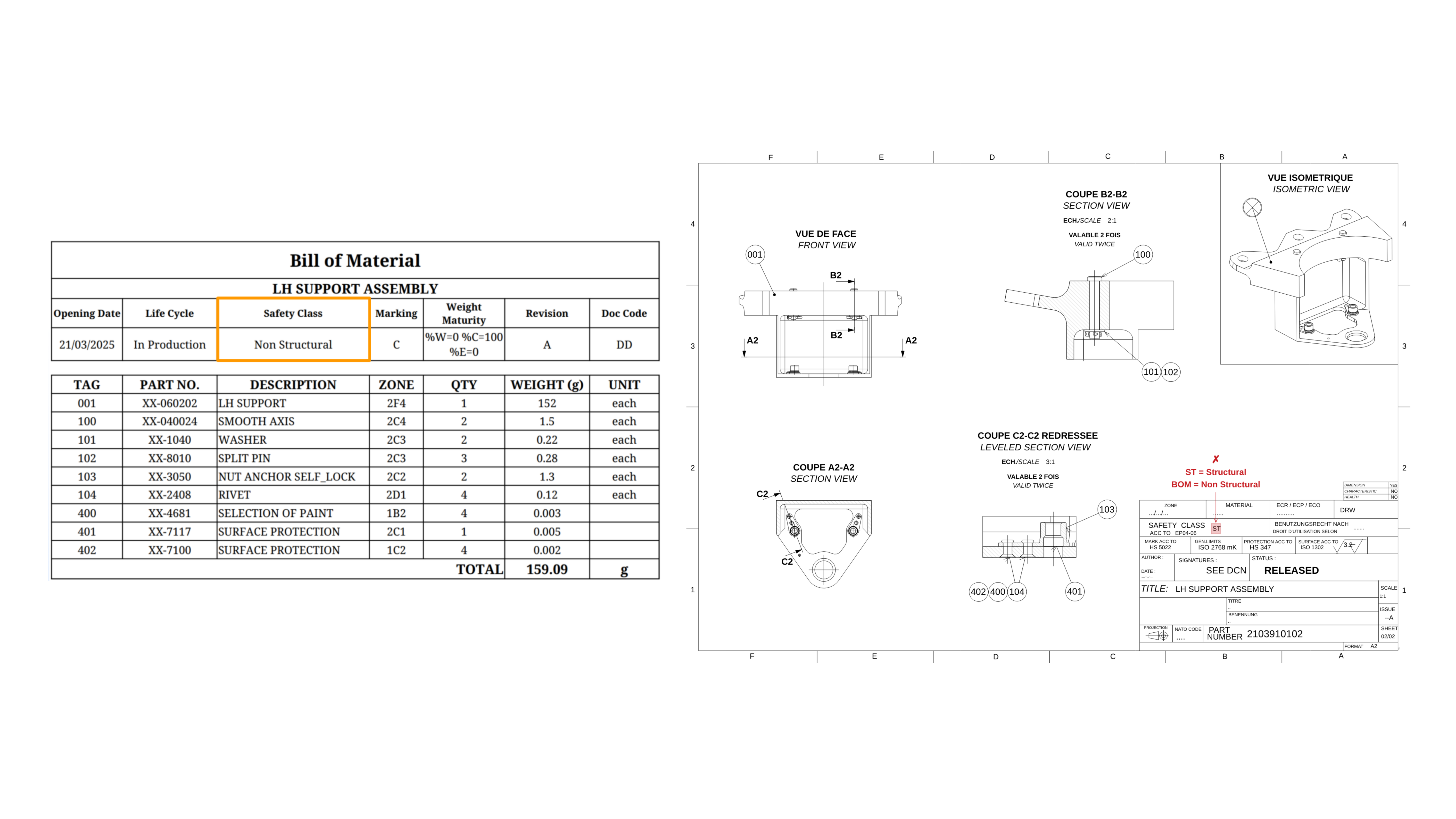
Parts can carry a safety classification — Structural or Non-Structural — that determines what level of inspection it requires. This value appears in two places: the drawing's title block and the BOM. They can be maintained by different people, and they drift.
When they don't match, the part gets routed through the wrong inspection process. That's not an admin error, it's a compliance finding.
Dessia checks both sources, normalizes the values, and flags any discrepancy with a clear message before release.
Section view completeness
A section line is a promise: it tells the reader that the corresponding cross-section view exists somewhere on the same sheet, or on other sheets.
When that view is missing — planned but never drawn, or moved without updating the reference — whoever reads it next either stops production to ask, or guesses.
Dessia checks that every section line points to an existing, clearly identified view. Broken references are flagged before they become production questions.

Standardization and template compliance
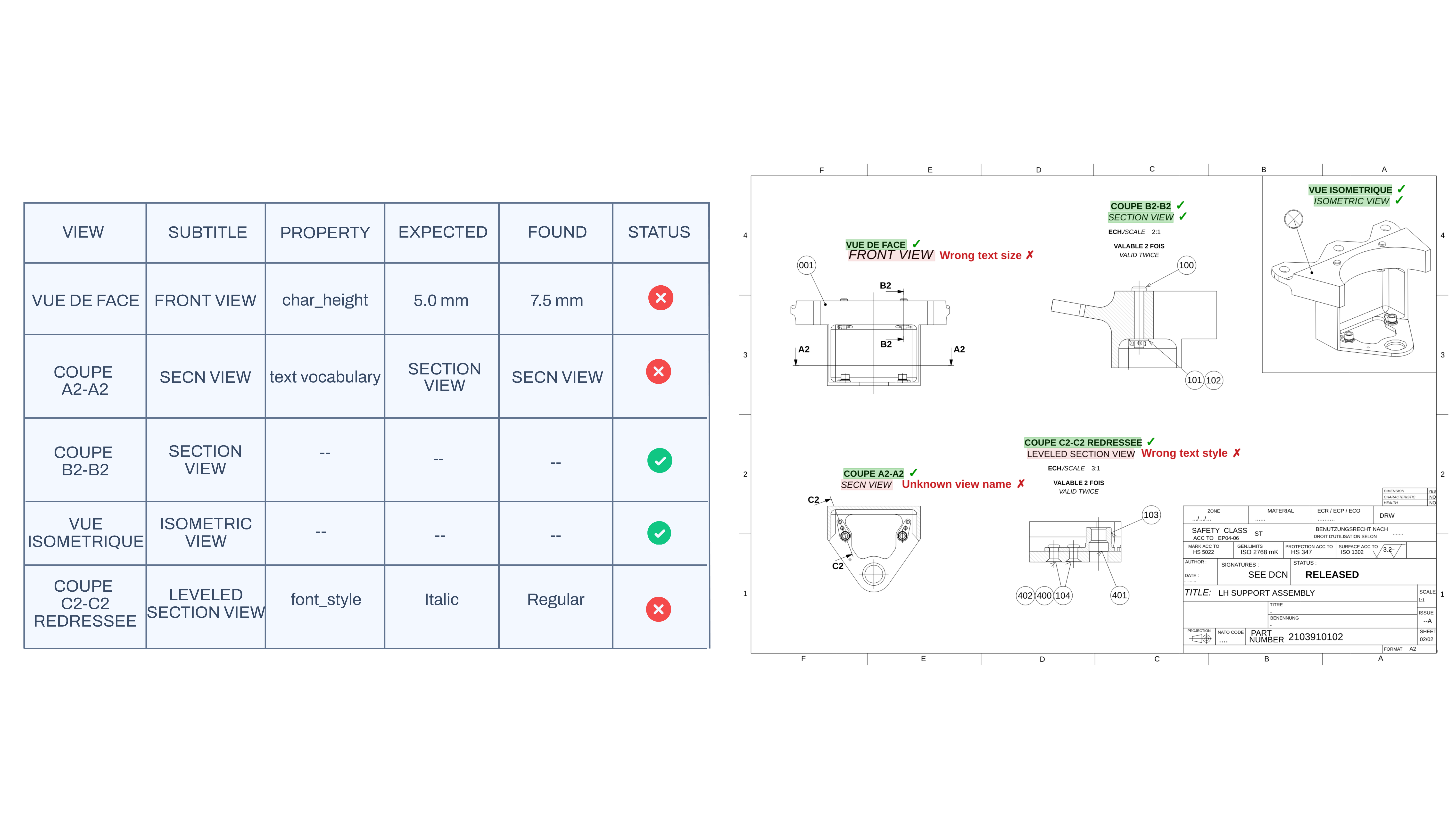
Every view has a title — a name, a type label, and formatting rules defined by the in-house CAD template.
A non-standard label or the wrong font size usually means the template could have been bypassed. And when the template is bypassed in one place, other conventions tend to follow.
Dessia checks every view title against the approved vocabulary and style rules, and surfaces any drift before it spreads.
Scale coherence across views
The title block sets the main scale for the whole drawing. Views that differ from it carry their own declaration. Views that match it should carry none.
If a view explicitly restates the main scale and the title block later gets updated, that view becomes wrong, with no automatic warning. Two conflicting scale references means parts sized to the wrong dimensions.
Dessia flags every redundant scale declaration and ensures each view always has one clear reference.

Title block and metadata completeness
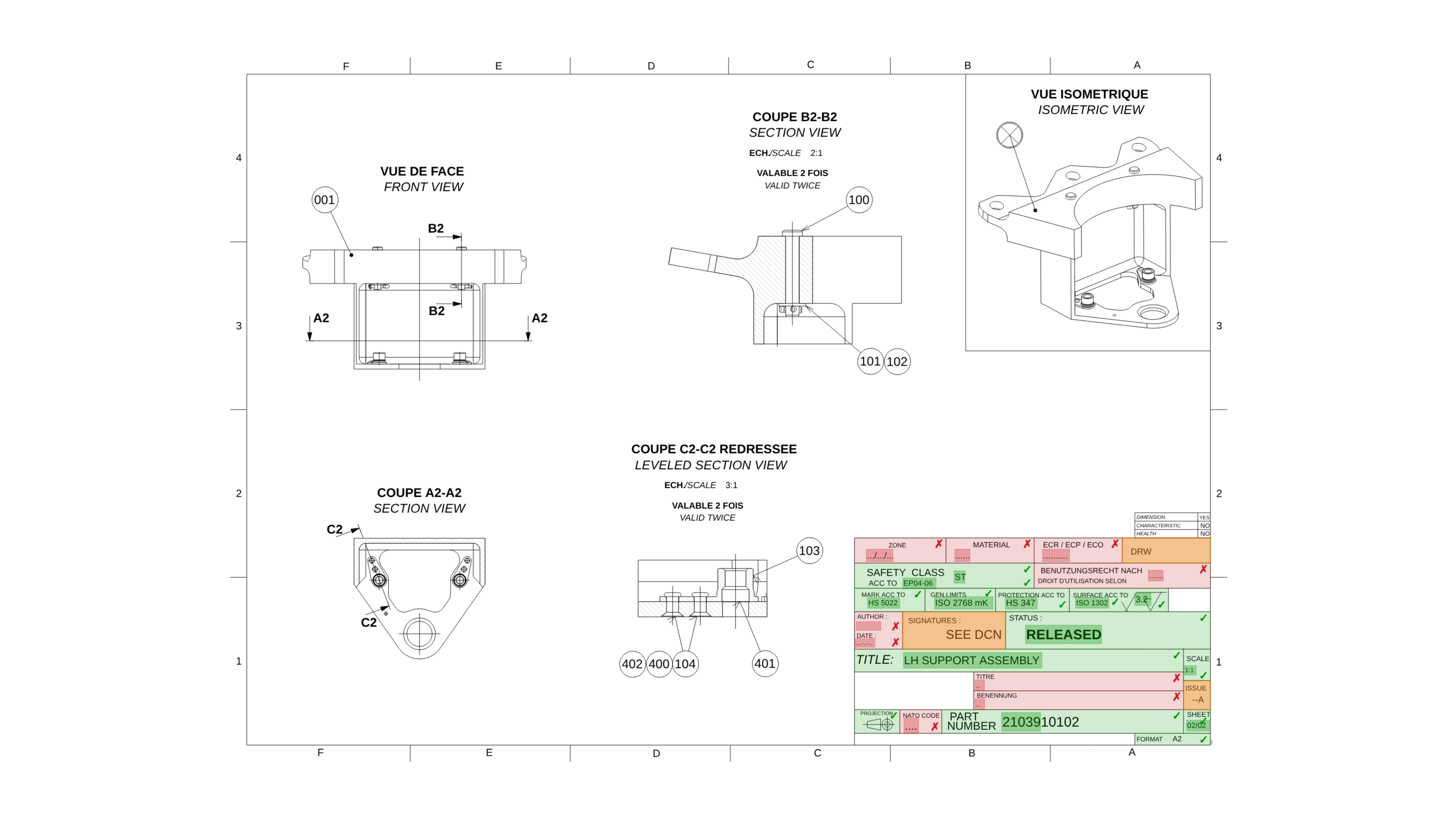
The title block is where part number, revision, material, and applicable standards live. Fields left blank or filled with placeholder text have no production value.
Beyond completeness, certain fields have format requirements: part numbers must follow internal conventions, surface finish must reference the right standard.
Dessia validates every required field before release. An incomplete title block gets caught here , not downstream.
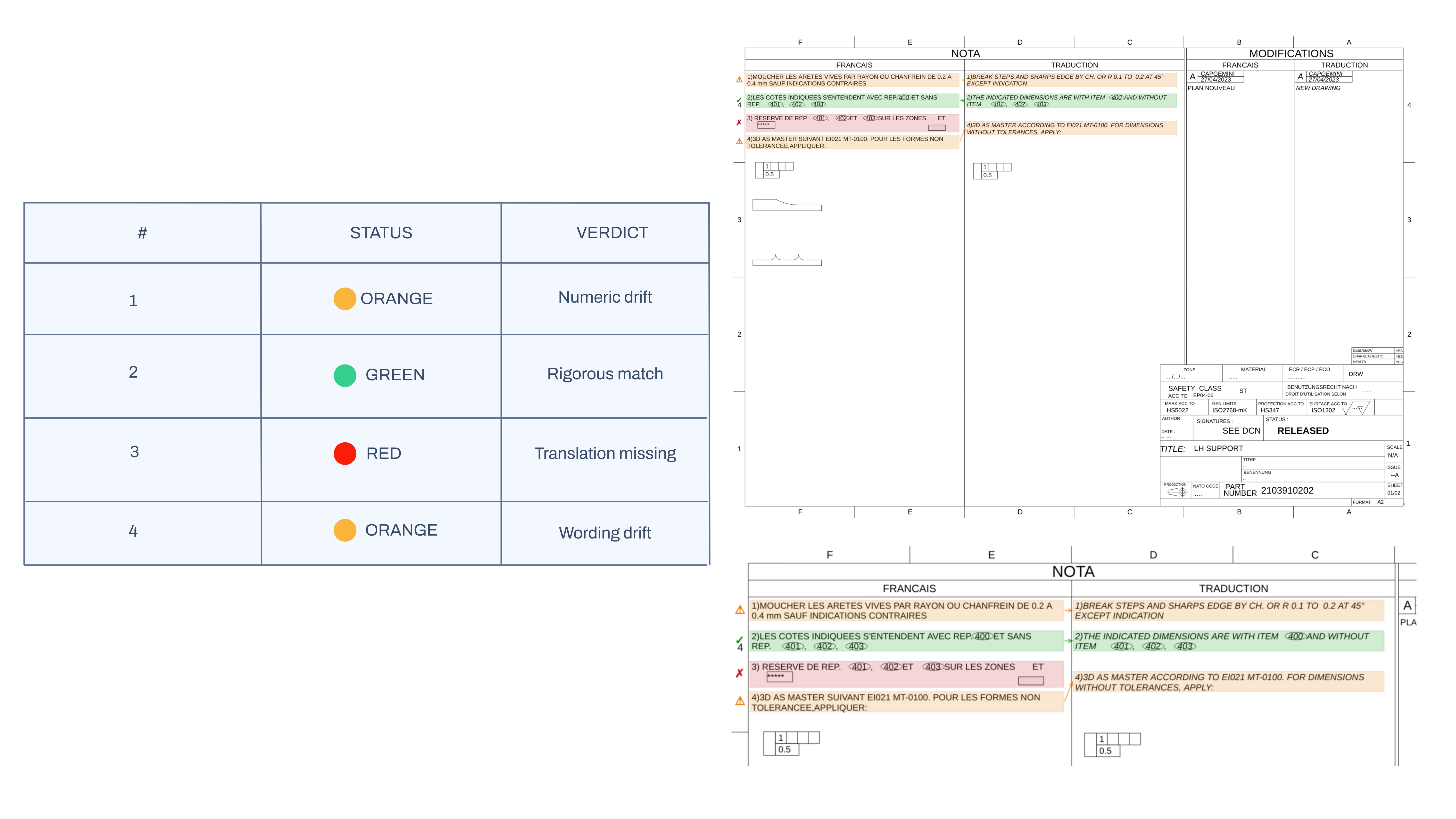
Multilingual note consistency
Drawings for international programs carry bilingual notes, French on one side, English on the other. These carry real production instructions: tolerance rules, scope qualifiers, applicable zones.
A missing translation means the instruction doesn't exist for part of the team. A drifted translation, a tolerance or angle silently changed, means someone is working to a different spec than the one the designer signed off on.
Dessia checks every note pair and flags both missing translations and numeric drift, the defect that's hardest to catch by eye.
Hatch pattern and visual consistency
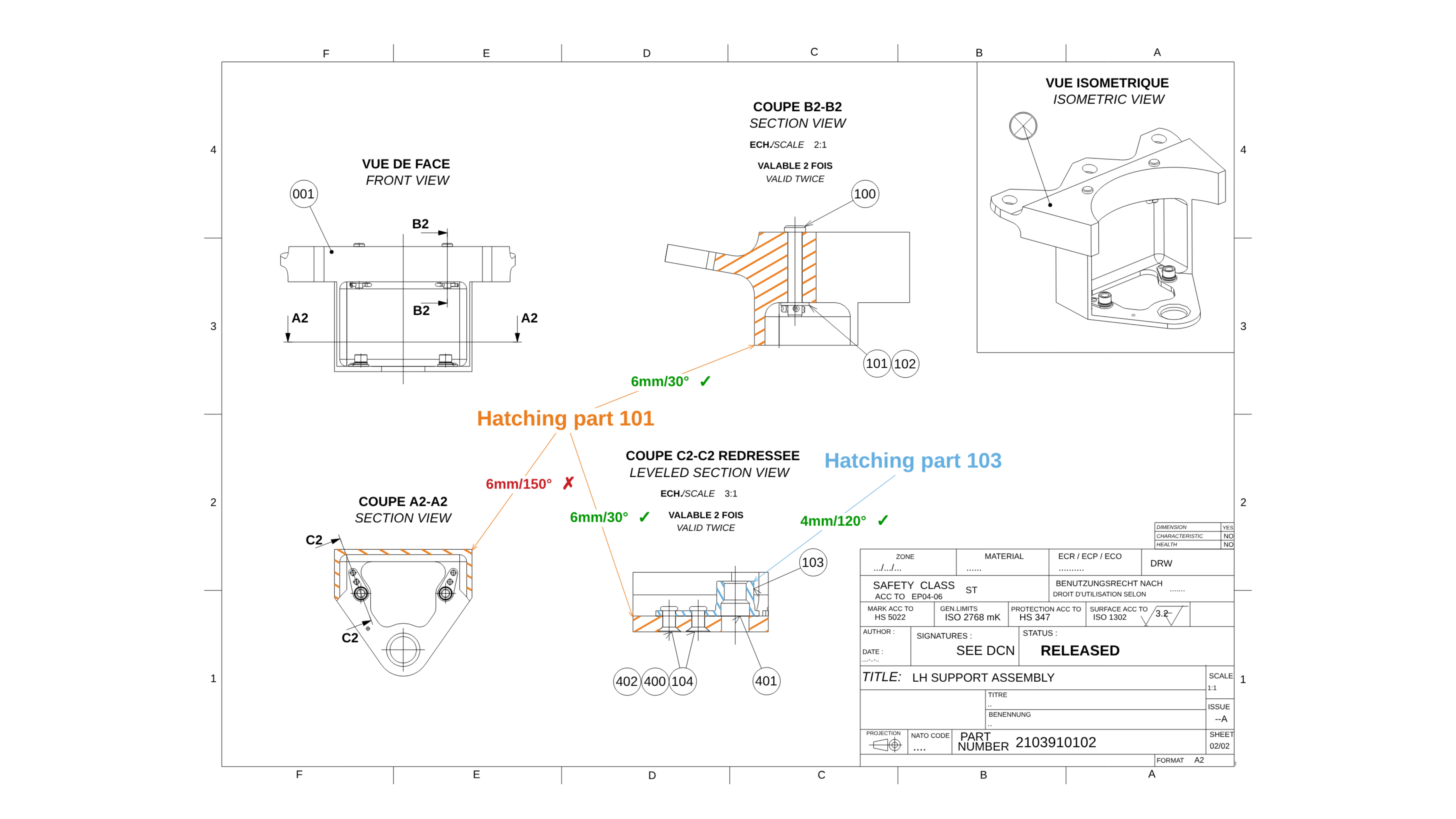
When a part appears in cross-section across multiple views, its hatching must be identical in every view — same angle, same spacing.
When it drifts, a reader is visually told there are two different parts where there is only one. It's completely invisible to any text-based tool.
Dessia's AI compares hatch patterns across views and flags any deviation, something no manual process does consistently.
Dimension integrity and standards compliance
A dimension carries a value, a symbol, a tolerance, and sometimes a unit. Each has rules.
A wrong unit, a missing diameter symbol, a tolerance that's physically unrealistic, these are the kinds of errors that get copy-pasted from a neighboring dimension and never noticed.
Dessia checks every dimension against applicable standards and flags anything that could change what gets machined.

Strategic impact
From quality gate to engineering intelligence infrastructure
The immediate value of AI-driven verification is error reduction. But framing it purely as a quality tool understates its strategic significance for engineering leadership.
When every check is rule-based, logged, and versioned, the validation layer becomes an active source of engineering intelligence. Patterns in recurring defect types reveal systemic gaps in templates or tooling. Drift rates across design teams expose process inconsistencies that were previously invisible. Release-readiness becomes a measurable, comparable metric rather than a subjective judgment.
This is the foundation of what leading engineering organizations are beginning to call continuous verification; a model in which quality assurance is not a discrete event at the end of the design process, but an ambient, automated layer integrated throughout it.
"The strategic advantage is not just fewer errors. It is predictability — the ability to make release decisions with confidence, scale best practices across global teams, and demonstrate compliance with structured, machine-generated evidence."
Why Dessia
What makes it different from everything else you’ve evaluated
Most verification tools give you a checklist. Dessia gives you an infrastructure. Here's what that means in practice:
- Fits into your existing environment : Dessia integrates with your CAD tools, PLM, and industrial software — cloud or on-premise, Python-based extensions included.
- Your rules, not ours : Verification logic is configured by your engineering standards team — versioned, auditable, and evolving with your processes.
- Located findings, not summary flags : Every anomaly includes its exact position on the drawing. Engineers handle exceptions, not investigations.
- Audit-grade traceability by default : Every check is logged — what rule ran, what it found, what the source was. Ready for regulatory submission, certification audits, and quality documentation.
- Scales with your programs : Same rules across every variant, every configuration, every release.
This approach is fully adaptable to each client’s context. Rules can be tailored to reflect your internal standards, engineering practices, and industry-specific constraints. The examples above are not exhaustive—they represent only a subset of what can be configured, extended, and validated within the platform.
Why now
The cost of waiting is no longer theoretical
Products are more complex. Regulations are stricter. More variants, more configurations, more interdependencies between CAD, BOM, and PLM — and more opportunities for inconsistencies to slip through undetected.
A drawing error caught before release costs a correction. The same error caught in manufacturing costs rework, delays, and a nonconformance report. Caught during a certification audit, it costs far more than that.

The engineering teams who are ahead are not reviewing more carefully. They are verifying systematically, at every release, with Dessia.
Keep exploring - Discover more case studies
AI for Knowledge Reuse
9
min reading