The Engineering intelligence gap: Why industrial programs struggle to turn data into decisions
Industrial programs drown in disconnected PLM, CAE & Excel data. See how Dessia's AI digital thread unifies engineering ecosystems for real-time convergence.
Executive summary
Industrial organizations managing complex product programs generate enormous volumes of engineering data — yet most of that data remains trapped inside disconnected tools, siloed trackers, and unstructured governance outputs. This case study examines how Dessia's AI-powered engineering intelligence platform creates a unified digital thread across fragmented engineering ecosystems, enabling continuous data synchronization, real-time impact analysis, and AI-driven decision intelligence throughout the product lifecycle.
The challenge: Engineering data fragmentation at program scale
Why the digital thread gap matters
In modern industrial programs, engineering knowledge is continuously generated across design offices, CAE teams, testing departments, manufacturing engineering, and program management. Despite this volume of available data, most organizations still fail to transform it into synchronized, actionable intelligence.
The problem is rarely a lack of data. It is the inability to structure, connect, and operationalize fragmented engineering knowledge across the enterprise.
As product architectures grow more complex, engineering teams become dependent on a sprawling ecosystem of disconnected tools: PDM data stored in systems such as Teamcenter or Enovia, internal eBOM platforms, CAE simulation outputs, test management databases, Excel-based trackers, and manually consolidated review documents. Each source captures a partial view of the product state. None delivers a unified, continuously updated engineering view.
This is, by definition, a broken digital thread — and it represents a critical gap between data availability and engineering intelligence.
Business impact: When fragmentation becomes a program risk
For program managers and chief engineers, engineering data fragmentation is not a tooling inconvenience — it is a strategic program risk. The consequences compound over time:
- Decisions are made from incomplete, asynchronous visibility
- Cross-functional reasoning — understanding how a design change cascades into validation status, plant integration constraints, or supplier dependencies — becomes slow and reactive
- Manual synchronization cycles create coordination overhead that scales poorly with program complexity
- Risk propagation is detected too late, increasing the cost of rework and iteration
As programs accelerate and product variant counts grow, this disconnected operating model introduces compounding inefficiency that becomes increasingly difficult to reverse.
Root cause analysis: The four dimensions of engineering data fragmentation
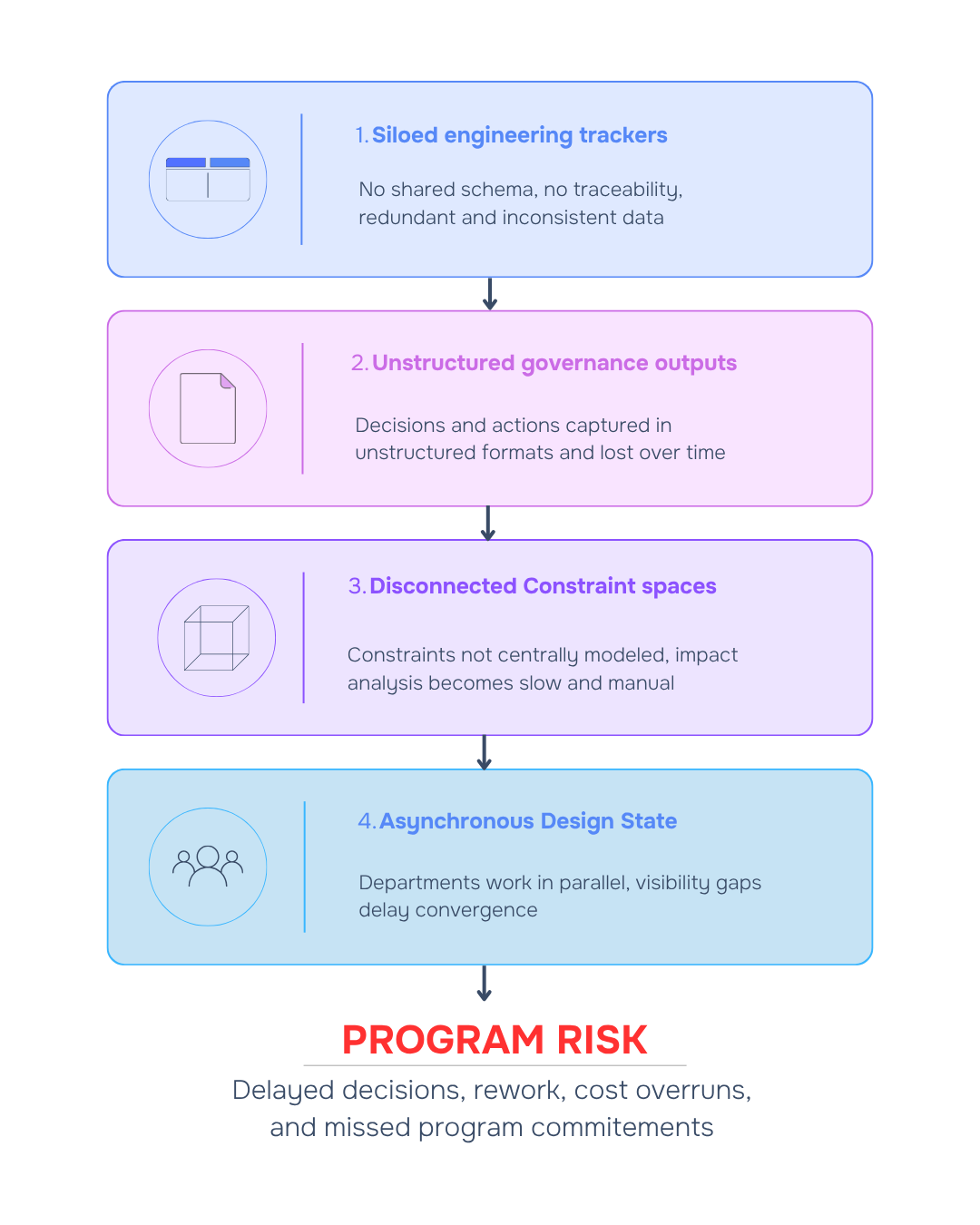
1. Siloed engineering trackers prevent cross-domain traceability
Engineering activities across most industrial programs are often managed through independent Excel-based trackers maintained by separate departments. Without a shared schema, synchronized identifiers, or unified traceability logic, these systems evolve in isolation.
The result: information redundancy becomes unavoidable, version consistency cannot be guaranteed, cross-domain dependencies go undetected, and engineering status reconciliation remains a manual, time-intensive process. The absence of interoperability turns engineering coordination into a continuous synchronization effort rather than an integrated workflow.
2. Unstructured governance outputs create knowledge dead ends
Working group reviews and program governance meetings generate critical engineering decisions, action plans, and risk assessments. Yet these outputs are almost always documented in unstructured formats — meeting notes, presentation slides, and manually updated action lists — that cannot be ingested into a machine-readable engineering model.
Action ownership becomes difficult to track. Closure status loses visibility over time. Decision rationale is rarely capitalized. And historical traceability across program iterations degrades into tribal knowledge. Engineering governance becomes dependent on manual follow-up rather than structured operational intelligence.
3. Disconnected constraint spaces block real-time impact analysis
Industrial programs operate under growing numbers of interdependent constraints: plant-specific hard points, manufacturing dependencies, packaging limitations, supplier conditions, and validation rules. In most organizations, these constraints are not centrally modeled or dynamically connected to the evolving product definition.
When engineering changes occur, impact analysis is slow, manual, and heavily dependent on expert knowledge. Without a structured constraint representation, organizations cannot anticipate downstream consequences before problems propagate across engineering domains — a critical failure point in complex, multi-variant programs.
4. Asynchronous design state prevents engineering convergence
When design engineering teams evolve in parallel with limited synchronization mechanisms, each department ends up maintaining its own partial representation of product maturity and validation status. Feedback loops are delayed. Status visibility is inconsistent. Design convergence slows. Risk propagation is detected too late.
Instead of operating from a shared engineering state model — a continuous digital thread — teams rely on fragmented snapshots of reality distributed across disconnected systems.
The solution: Dessia's AI-powered digital thread and engineering intelligence framework
Creating a unified engineering state model
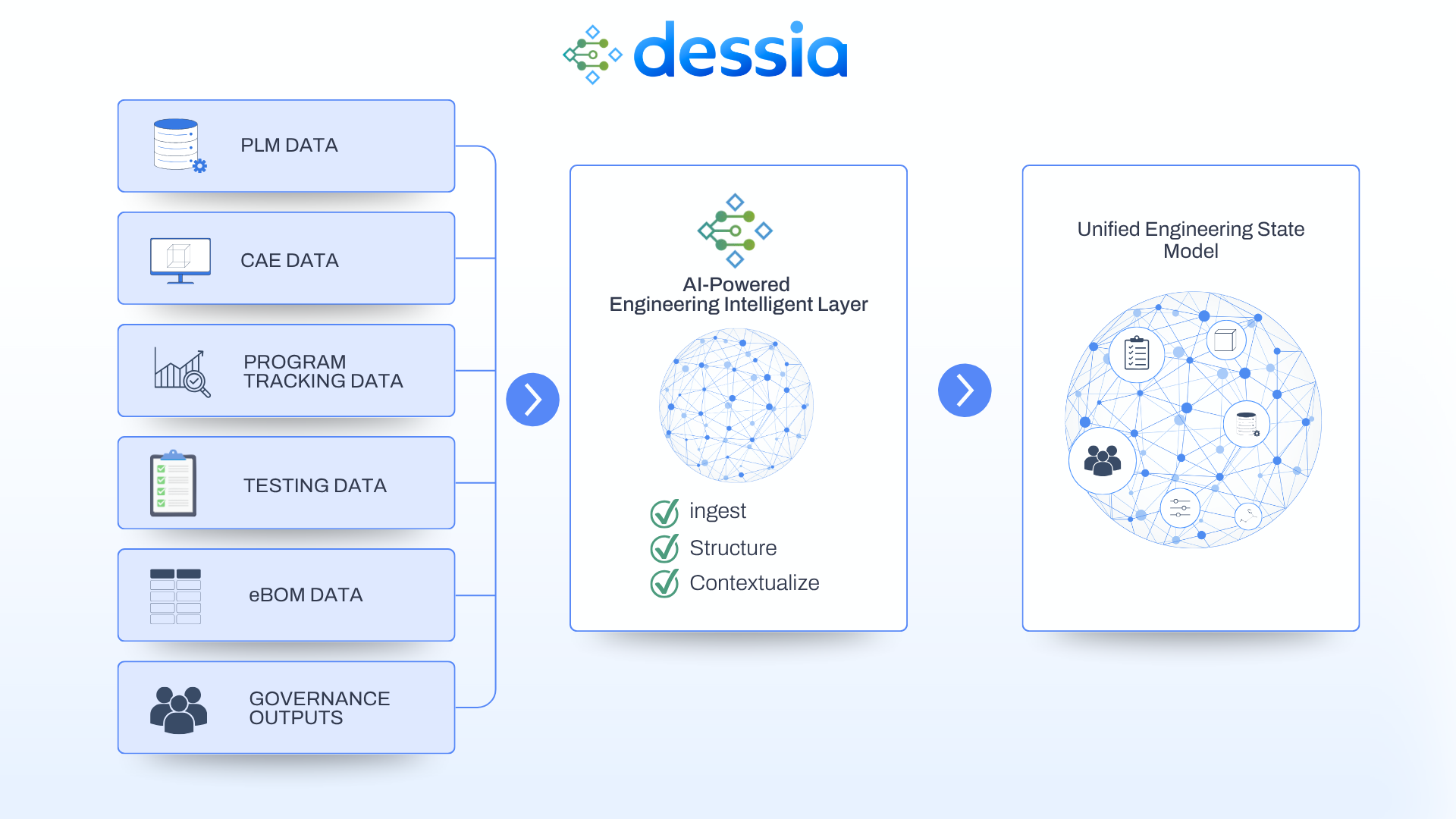
To address engineering data fragmentation at program scale, Dessia adds an intelligent operational layer on top of existing engineering systems and workflows. Rather than replacing enterprise infrastructure such as Teamcenter, Enovia, iBOM platforms, CAE environments, or testing databases, Dessia's engineering intelligence framework connects these fragmented data sources into a unified operational reasoning environment.
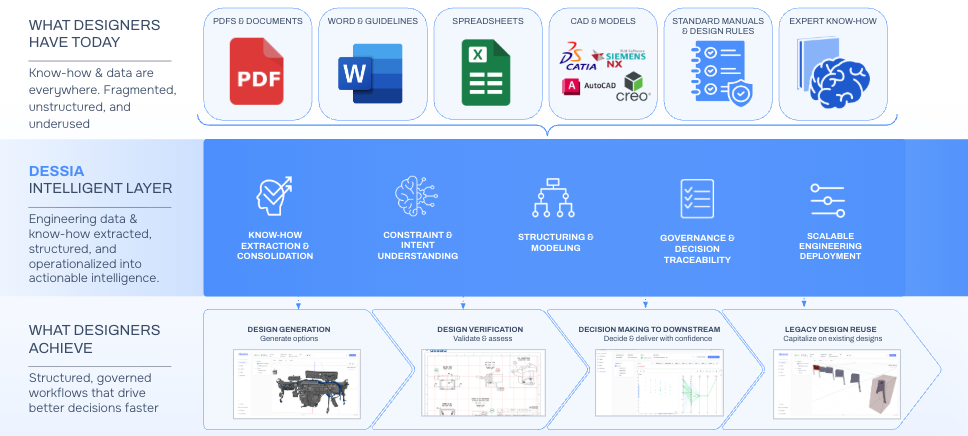
With Dessia librairies, customized agents can be set up to continuously ingest, structure, and contextualize engineering data from across the product lifecycle, including:
- Product structures and configurations
- Validation and verification workflows
- CAE simulation and testing outputs
- Manufacturing and plant constraints
- Program governance actions and risk assessments
- Engineering incidents and change requests
- Cross-functional dependency mappings
By transforming heterogeneous engineering data into a continuously updated operational graph, Dessia creates the digital thread that most PLM implementations promise but rarely deliver: a shared engineering state model that dynamically links product maturity, validation status, industrial constraints, risks, and program convergence indicators.
From disconnected workflows to continuous engineering reasoning
Most industrial organizations remain heavily dependent on manual consolidation loops between departments for engineering synchronization. Engineering teams spend significant time reconciling inconsistent trackers, rebuilding incident traceability, and synchronizing program maturity across disconnected systems.
Dessia's intelligent operational layer eliminates this fragmentation by enabling continuous engineering reasoning across the full ecosystem. Using structured engineering relationships, Dessia's AI algorithms can:
- Detect inconsistencies between engineering states across domains
- Identify unresolved cross-functional dependencies before they become blockers
- Surface missing validation coverage in real time
- Monitor convergence gaps between engineering departments
- Trace downstream impacts of design modifications
- Detect recurring incident patterns using AI-driven analysis
Rather than waiting for governance reviews or late-stage escalations, design teams gain continuous, real-time visibility into program synchronization, dependency propagation, and engineering convergence risks.
Most importantly, because engineering design data is continuously structured inside a unified operational model, Dessia enables organizations to generate on-demand operational views tailored to specific engineering, validation, manufacturing, supply chain, or program management needs.
Through configurable queries applied to the unified engineering knowledge base, teams can instantly access the information required to support operational and strategic decisions. Whether identifying impacted components, tracking validation status, monitoring unresolved actions, analyzing dependency chains, or reviewing program maturity indicators, decision-makers always work from a synchronized and continuously updated source of truth.
These dynamically generated dashboards transform fragmented engineering information into actionable intelligence. Instead of spending time consolidating data from multiple systems, teams can focus on understanding risks, evaluating trade-offs, and prioritizing actions.
By providing immediate visibility into bottlenecks, unresolved dependencies, validation gaps, and program convergence risks, Dessia helps organizations improve decision quality, reduce costly rework, and accelerate engineering convergence across the product lifecycle.
AI-driven multi-criteria engineering decision intelligence
In software-defined, variant-intensive industrial systems, engineering organizations must continuously arbitrate between multiple competing constraints: validation maturity, manufacturing feasibility, packaging requirements, program timing, cost targets, supplier dependencies, and system performance.
Dessia structures these interdependencies into a continuously evolving operational intelligence model — creating the technical foundation for AI-driven multi-criteria engineering optimization. Engineering teams can perform dynamic impact analysis across interconnected parameters instead of analyzing problems in isolated silos.
The result is a more scalable approach to engineering convergence: decisions evaluated earlier, risks anticipated faster, and engineering knowledge operationalized across the full program lifecycle.
Results
By implementing a continuous digital thread and AI-powered reasoning layer across a fragmented engineering ecosystem, Dessia delivered measurable improvements across five dimensions:
- Faster engineering convergence cycles : reduced time to align across engineering domains
- Reduced manual synchronization overhead : fewer consolidation loops, less coordination waste
- Improved cross-functional traceability : end-to-end visibility from design intent to validation closure
- Earlier detection of downstream risks : proactive risk propagation analysis instead of reactive escalation
- Improved engineering knowledge capitalization : governance outputs, incident data, and decision rationale preserved and queryable
Most importantly, engineering intelligence became continuously operational — rather than remaining trapped inside disconnected enterprise systems, spreadsheets, and tribal workflows.
Conclusion: Engineering the digital thread at industrial scale
As product complexity, software integration, and variant proliferation continue to grow, fragmented workflows and disconnected data models become direct barriers to industrial scalability and engineering decision quality.
This case study demonstrates how Dessia's AI-powered engineering intelligence framework enables industrial organizations to establish a true digital thread: structuring, synchronizing, and operationalizing complex engineering data at scale — across PLM systems, CAE environments, testing infrastructure, and manufacturing constraints.
By transforming fragmented engineering data into a continuously connected operational intelligence model, Dessia enables a new generation of AI-driven engineering synchronization, cross-domain reasoning, and product lifecycle decision intelligence.
Keep exploring - Discover more case studies
AI Verification & Validation
9
min reading
AI for Knowledge Reuse
9
min reading