LLM vs. AI Agent vs. Agentic Harness: What Makes AI Reliable for Engineering?
An LLM can explain an engineering problem. But can it execute CAD checks, apply design rules, and produce verifiable results? Explore the differences between LLMs, AI agents, and agentic harnesses, and discover how Lagrangia connects AI reasoning with real engineering intelligence.
A large language model can generate an answer in seconds. But can it verify a CAD model, apply engineering constraints, execute multiple technical checks, and produce results that engineers can reproduce?
That is where the difference between an LLM, an AI agent, and an agentic harness becomes critical.
As artificial intelligence moves deeper into industrial engineering, the challenge is no longer simply making AI more intelligent. It is making AI capable of operating on real engineering data, using specialized tools, following defined rules, and producing results that can be independently verified.
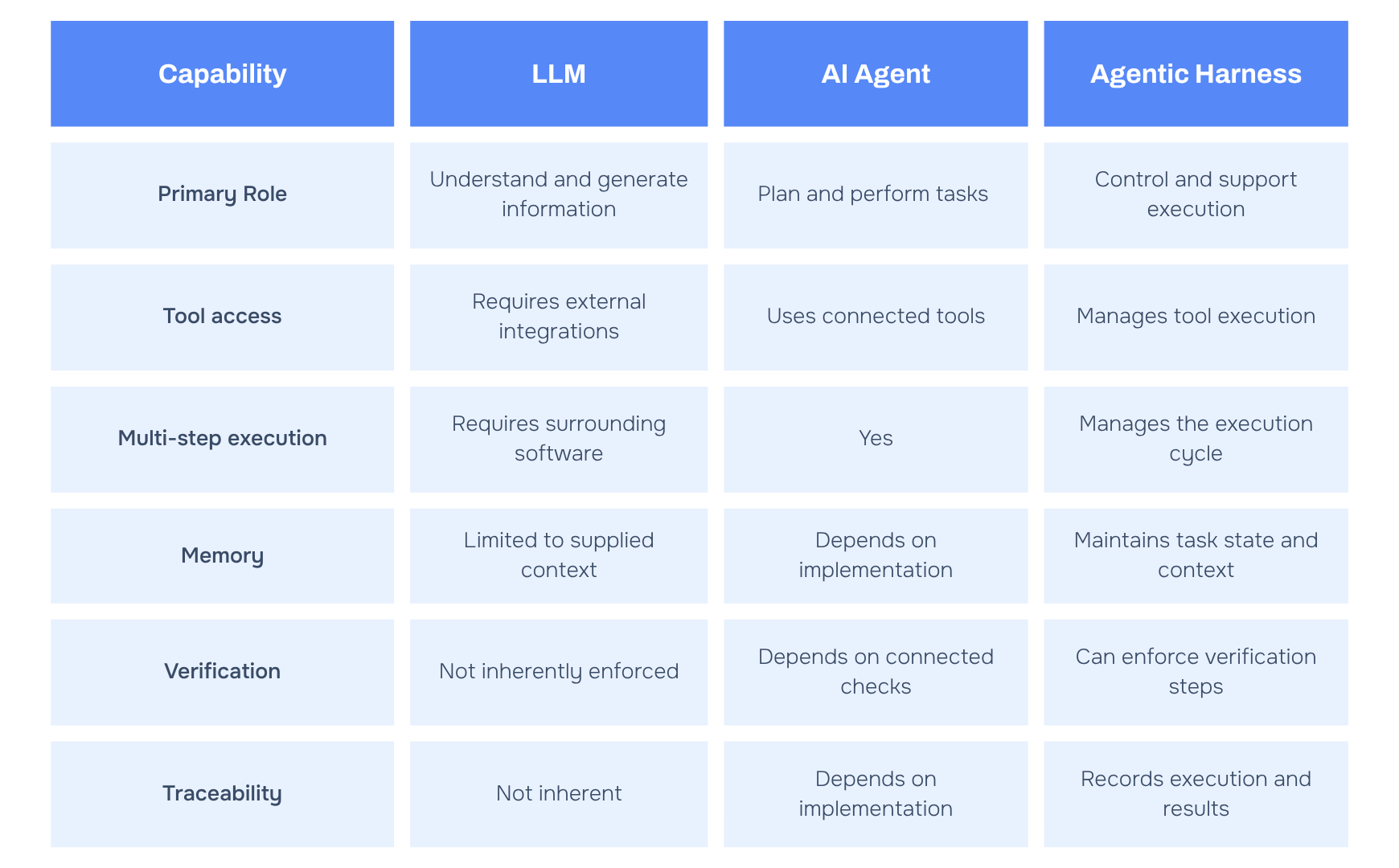
The short answer: An LLM provides language understanding and reasoning capabilities. An AI agent uses those capabilities to pursue objectives and perform actions. An agentic harness provides the execution environment, tools, memory, controls, and verification mechanisms that make those actions manageable and repeatable.
For engineering teams, this distinction changes everything.
LLM vs. AI Agent vs. Agentic Harness: What's the difference?
The three concepts are closely connected, but they serve different purposes.
An LLM can explain how to check the clearance between two components.
An AI agent can initiate the required geometric analysis using connected tools.
An agentic harness manages how those tools are called, which engineering rules are applied, what happens when a check fails, and how the execution is recorded.
The difference is not simply what AI knows. It is what the entire system can reliably do with that knowledge.
Why are LLMs alone not enough for engineering?
Large language models have transformed access to technical knowledge. Engineers can query complex documentation, interpret specifications, and explore technical questions through natural language.
However, language understanding and engineering verification are fundamentally different capabilities.
Consider a simple question:
"Does this assembly respect the minimum clearance required between all relevant components?"
An LLM may explain the applicable principles, propose verification methods, or generate code intended to calculate distances.
But answering the question correctly requires access to the actual CAD geometry, the relevant engineering rules, and a method for evaluating the result.
The system needs to identify components, perform geometric calculations, compare measurements against specified limits, and report any non-compliance.
An LLM's confidence in an answer is not evidence that these operations were performed.
In industrial engineering, this distinction is essential. A plausible recommendation is useful, but an engineering decision requires supporting evidence.
That is why the future of AI in engineering depends not only on more capable models, but also on the infrastructure surrounding them.
What is an Agentic AI harness?
An agentic AI harness is the software infrastructure surrounding an AI model that enables it to interact with external tools, execute multi-step tasks, maintain context, apply controls, and evaluate results.
Rather than treating every prompt as an isolated interaction, the harness creates a structured environment for executing tasks over multiple steps.
Five capabilities are particularly important:
1. Tool orchestration
The harness connects the model to specialized software, APIs, MCP and CLI technical data, and calculation engines. It manages how these tools are selected and called.
2. Execution and iteration
Complex tasks rarely succeed through a single action. The harness supports an execution cycle in which actions produce results, those results are evaluated, and subsequent steps are adjusted when necessary.
3. Memory and context persistence
Engineering tasks often involve multiple parameters, previous decisions, intermediate calculations, and evolving constraints. The harness maintains relevant information throughout execution.
4. Guardrails and verification
The harness can establish boundaries around tool execution, apply validation rules, and require checks before results are accepted or actions proceed.
5. Reproducibility and traceability
By preserving execution context, tool outputs, rule references, and verification results, the harness provides the foundation for repeatable and auditable engineering operations.
These capabilities do not automatically make every AI-generated result correct. Instead, they make the execution process more controlled, observable, and verifiable.
Introducing Lagrangia: Dessia's Agentic Harness for Engineering
General-purpose AI agents can perform a wide variety of digital tasks. Industrial engineering, however, introduces a different set of requirements.
Engineering intelligence depends on more than documents or textual knowledge. It must account for real product geometry, requirements, design rules, dependencies, and technical decisions.
This is the environment for which Lagrangia, Dessia Technologies' agentic harness, is designed.
Lagrangia connects the reasoning capabilities of AI models with the specialized engineering intelligence available through the Dessia platform.
Rather than relying on generated text alone, it enables specialized engineering agents to work with structured technical knowledge and Dessia geometry-aware tool.
1. Connecting AI reasoning to real engineering data
Engineering knowledge is often fragmented across CAD models, PLM systems, guidelines documents, requirements, and the expertise of individual engineers.
Lagrangia operates with Dessia's CAD-aware intelligence layer, which connects engineering geometry with technical knoweldge and product information.
This gives specialized agents access to the context needed to address real engineering questions rather than reasoning from textual descriptions alone.
2. Orchestrating specialized engineering tools
A language model may identify which technical operations are needed, but those operations must be performed by suitable tools.
Lagrangia provides the orchestration required to connect AI reasoning with engineering capabilities such as geometric analysis, shape recognition, similarity search, and rule-based verification.
Instead of manually initiating each operation, engineers can define an objective and let the agent coordinate the relevant capabilities.
3. Maintaining context across multiple engineering steps
A technical verification may depend on dozens of intermediate operations.
The system may need to identify reference geometry, recognize relevant features, calculate measurements, and compare the results with requirements.
Lagrangia's harness architecture is designed to preserve the context of these operations, supporting continuity between steps and iterative refinement when necessary.
This is particularly important when a task depends on previous calculations, stored engineering rules, or earlier verification results.
4. Making engineering results reproducible and traceable
A valuable engineering result must be more than plausible. Teams need to understand how it was obtained.
Lagrangia is designed to support reproducibility by coordinating specialized tools, retaining execution context, and integrating verification within the agent's execution process.
With controlled input data, documented rules, and identifiable tool versions, teams can reproduce technical checks and examine the evidence supporting an outcome.
The objective is not to eliminate engineering judgment, but to make AI-driven execution sufficiently structured for engineers to review, verify, and trust.
5. Turning engineering knowledge into reusable capabilities
One of the largest barriers to engineering automation is the effort required to convert expertise into executable operations.
Dessia addresses this challenge by structuring engineering knowledge into reusable tools and specialized agents.
Lagrangia extends this approach through AI-driven knowledge structuring, tool assembly, and agent orchestration.
Instead of rebuilding the same technical logic for every new engineering problem, teams can reuse available capabilities and adapt them to additional applications.
The result is a more direct connection between an engineer's objective and the technical operations needed to address it.
Engineering Example: LLM vs. Lagrangia for CAD Verification
Consider an engineering team that needs to verify whether a repeated geometric feature respects a defined minimum distance from a reference surface.
The objective sounds simple, but performing the check requires several technical operations.
Approach A: using an LLM + generic agent alone
The design engineer describes the problem to an LLM.
The model can suggest a verification method, explain which geometric measurements matter, and perhaps generate a script.
However, without connected execution tools, it cannot independently inspect the source CAD model or establish whether the rule has been satisfied.
The design engineer must still perform the calculations and verify the output.
Approach B: Using a specialized agent through Lagrangia
Unlike a standalone LLM, Lagrangia is connected to Dessia's engineering SDK, which provides the executable engineering logic, algorithms, and specialized tools needed to perform real technical operations.
The SDK allows engineering knowledge, geometric calculations, and design rules to be translated into reusable capabilities. Lagrangia orchestrates these capabilities, combining AI reasoning with established engineering logic rather than relying on model-generated answers alone.
For our CAD verification example, the agent can coordinate a structured sequence:
Access the 3D CAD geometry and identify the relevant components and reference surfaces.
Invoke SDK capabilities to recognize geometric features and retrieve the appropriate engineering logic.
Execute geometric calculations using specialized algorithms available through the SDK.
Apply engineering rules and constraints to verify whether the measured values meet the specified requirements.
Generate structured verification results, identifying compliant and non-compliant features.
Preserve execution context and verification evidence, making the results traceable and reproducible.
If a check fails or produces an unexpected result, Lagrangia can manage further execution steps within defined safeguards, while maintaining the context of previous operations.
The key distinction is that the LLM provides reasoning, the Dessia SDK provides executable engineering intelligence, and Lagrangia connects and orchestrates both.
The result is not simply an AI-generated recommendation, but an engineering analysis grounded in actual CAD geometry, reusable technical logic, and verifiable calculations.
This is what makes the combination powerful: AI reasoning connected to real engineering logic, with controlled execution, reproducibility, and traceability built into the process.
Why does reproducibility matter for engineering AI agents?
Reproducibility is an essential requirement for industrial engineering.
Design decisions must often be reviewed across teams, checked after revisions, and evaluated against the same technical requirements.
An AI system that produces different conclusions without a clear explanation of what changed creates uncertainty rather than reducing it.
For engineering AI agents, reproducibility means being able to establish:
Which input data was evaluated
Which rules and tool versions were applied
Which calculations and checks were performed
What results were produced
Whether a repeated execution reaches the same verified outcome under equivalent conditions
A harness makes it possible to manage and record these elements systematically.
For Dessia, this principle is central to Lagrangia's architecture: agentic AI should not be judged only by how effectively it generates responses, but by how reliably its actions can be controlled, examined, and reproduced.
Does a more powerful LLM eliminate the need for an agentic harness?
No. Improving the model and improving the execution infrastructure address different problems.
A stronger LLM may interpret instructions more effectively, select appropriate tools more accurately, and handle complex reasoning with fewer errors.
But model capability does not replace access to live engineering data, geometric computation, rule execution, persistent task state, or traceable verification.
These requirements exist independently of model intelligence.
Even the most capable language model needs an external system to execute a CAD measurement and verify its result against an engineering constraint.
The harness provides this operating environment.
For engineering organizations, the relevant question therefore becomes:
How can we combine increasingly capable AI models with specialized engineering knowledge and controlled execution?
Lagrangia represents Dessia's approach to answering that question.
What should engineering teams look for in an AI agentic harness?
Not every agentic AI system is suitable for engineering applications.
When evaluating an AI harness for industrial use, organizations should consider several requirements.
Engineering data integration: Can the system operate on actual CAD geometry, requirements, and product data rather than textual approximations?
Specialized tool execution: Can it perform engineering calculations and use existing technical capabilities?
Verification: Can outputs be checked against defined engineering rules?
Context management: Can it preserve the relevant information across multiple execution steps?
Traceability: Can engineers inspect the inputs, actions, checks, and results?
Knowledge reuse: Can existing engineering expertise be converted into reusable capabilities rather than repeatedly reconstructed?
These criteria help distinguish a general-purpose AI experience from infrastructure designed for technical engineering operations.
Lagrangia brings these principles together within Dessia's broader engineering intelligence environment, connecting agent reasoning to the geometry, knowledge, and verification capabilities required for industrial applications.
Conclusion: The future of engineering AI depends on more than the model
Large language models made artificial intelligence easier to interact with. AI agents are making it possible to turn those interactions into actions.
The agentic harness is what connects those actions to an environment designed for controlled execution.
For engineering, where geometry, rules, traceability, and reproducibility matter, that distinction is fundamental.
With Lagrangia, Dessia Technologies is building toward an approach in which AI reasoning connects directly to specialized engineering tools, structured knowledge, and verifiable technical results.
The objective is not simply to make AI generate better answers. It is to make engineering intelligence actionable, repeatable, and grounded in real product data.
Because the future of engineering AI will not be defined by what a model can say, but by what an engineering system can reliably execute and verify.
Frequently Asked Questions
What is the difference between an AI agent and an agentic harness?
An AI agent is a system that uses AI to pursue objectives and perform tasks. An agentic harness is the software environment that supports the agent's execution by managing tools, memory, permissions, feedback, and verification. The harness is part of what enables an agent to operate beyond a single model response.
Can an LLM verify a CAD model?
An LLM cannot independently validate real CAD geometry through text generation alone. It needs access to appropriate geometric analysis and rule-checking tools. When integrated into an engineering agent system, an LLM can help coordinate those tools and interpret their results.
What makes Lagrangia different from a general-purpose AI agent?
Lagrangia is built around engineering-specific capabilities through the Dessia platform, including CAD-aware intelligence, geometric analysis, engineering rules, knowledge reuse, and verification. Its purpose is to connect AI reasoning with actual engineering operations, not simply generate textual recommendations.
Can an agentic harness guarantee correct AI results?
Not by itself. A harness improves control, repeatability, and observability, but correctness still depends on the input data, engineering rules, tools, and verification methods. Human review remains essential where technical risk demands it.
How does an agentic harness reduce AI hallucination risks?
An agentic harness can reduce dependence on unsupported model-generated claims by using external tools and checking outputs against defined requirements. It does not eliminate hallucinations, but it provides mechanisms for detecting errors and preventing unverified answers from being treated as validated engineering conclusions.
An LLM can explain an engineering problem. But can it execute CAD checks, apply design rules, and produce verifiable results? Explore the differences between LLMs, AI agents, and agentic harnesses, and discover how Lagrangia connects AI reasoning with real engineering intelligence.
Most industrial AI pilots fail to scale because they add AI on top of fragmented engineering data (CAD, PLM, requirements, BOMs, test reports) instead of connecting that data first. An Engineering Intelligence Layer turns disconnected engineering files into a connected knowledge graph, giving AI the context it needs to produce trustworthy, traceable engineering decisions—not just plausible-sounding text.