From knowledge loss to intelligent knowledge reuse: The industrial AI challenge of 2026
Industrial organizations have accumulated decades of CAD models, BOMs, and validated engineering decisions — yet most engineers still redesign parts that already exist. In 2026, the challenge isn't digitalization: it's making existing knowledge reusable. This piece explores how AI closes the engineering intelligence gap across design, procurement, and aftermarket operations.
Industrial organizations are sitting on decades of untapped engineering knowledge
For decades, engineering organizations have accumulated enormous amounts of technical knowledge. CAD models, drawings, BOMs, specifications, validation reports, supplier references, manufacturing decisions, and repair records collectively represent thousands of engineering-years of expertise.
Yet despite this wealth of information, most organizations struggle to reuse it effectively.
When engineers start a new project, they often redesign components that already exist. Purchasing teams negotiate similar parts independently, with no visibility into component standardization or parts rationalization opportunities. Aftermarket teams search manually for replacement parts when original components become obsolete.
The challenge in 2026 is no longer collecting engineering data. It is transforming historical engineering knowledge into a reusable, AI-accessible asset.
As product complexity increases and experienced engineers retire, the ability to identify, retrieve, and leverage existing institutional knowledge is becoming one of the most critical competitive differentiators in industrial manufacturing.
Why engineering knowledge disappears faster than organizations realize
Most industrial companies believe they have preserved their knowledge because they have stored their data. But storing information and making it reusable are fundamentally different problems.
A component designed ten years ago may still exist in a PLM system. A supplier decision may be buried in a spreadsheet. A validated repair solution may be archived in a project folder no one opens anymore.
The data exists. The actionable knowledge does not.
Because engineering information is distributed across disconnected CAD, PLM, ERP, and document systems — what analysts call engineering data fragmentation — teams have no practical way to discover that a similar solution was already developed elsewhere in the organization.
The result is a continuous cycle of rediscovery instead of reuse:
Purchasing teams manage unnecessary part proliferation without visibility into consolidation opportunities
Aftermarket teams struggle to identify interchangeable or substitute components
Domain expertise remains trapped inside individual programs with no cross-program standardization
Institutional knowledge walks out the door when senior engineers retire, taking undocumented design intent with them
This is the engineering intelligence gap: the distance between the data organizations own and the decisions they can actually make from it.
What is engineering knowledge reuse — and why does it matter now?
Engineering knowledge reuse is the capability to systematically identify, retrieve, and apply existing design solutions, validated components, and accumulated engineering decisions to new projects — rather than redeveloping them from scratch.
In the context of modern AI-driven engineering, knowledge reuse goes beyond keyword search in a PLM system. It means leveraging geometric similarity analysis, knowledge graphs, functional classification, part family management, and AI-powered pattern recognition to surface relevant precedents across millions of historical assets.
This shift is becoming urgent for three reasons:
The retirement wave. A significant share of senior engineers in aerospace, defense, and automotive will retire over the next decade, taking irreplaceable domain knowledge with them.
Accelerating product complexity. Systems like electric vehicles, next-generation aircraft, and industrial robots involve thousands of interdependent components — far beyond the scope of manual knowledge management or traditional engineering data management (EDM).
The AI agent era. As organizations deploy AI agents for engineering design, those agents are only as effective as the structured knowledge they can access. Unstructured archives are invisible to AI.
How AI transforms engineering repositories into active knowledge systems
The next generation of engineering intelligence platforms bridges this gap by identifying relationships between products, components, and engineering decisions that would otherwise remain invisible in siloed data systems.
Rather than searching only by part number or exact reference, engineers can search based on:
System architecture - interfaces, constraints, integration context
Historical usage patterns - where and how a component has been used before
This transforms engineering repositories from passive archives into active, AI-queryable knowledge systems — what leading organizations are beginning to call a single source of truth for engineering intelligence.
Instead of asking "Do we already have this exact part?", engineering teams can ask "Have we ever designed something like this?" — and get a ranked, evidence-backed answer in seconds.
This shift unlocks three strategic capabilities across the product lifecycle.
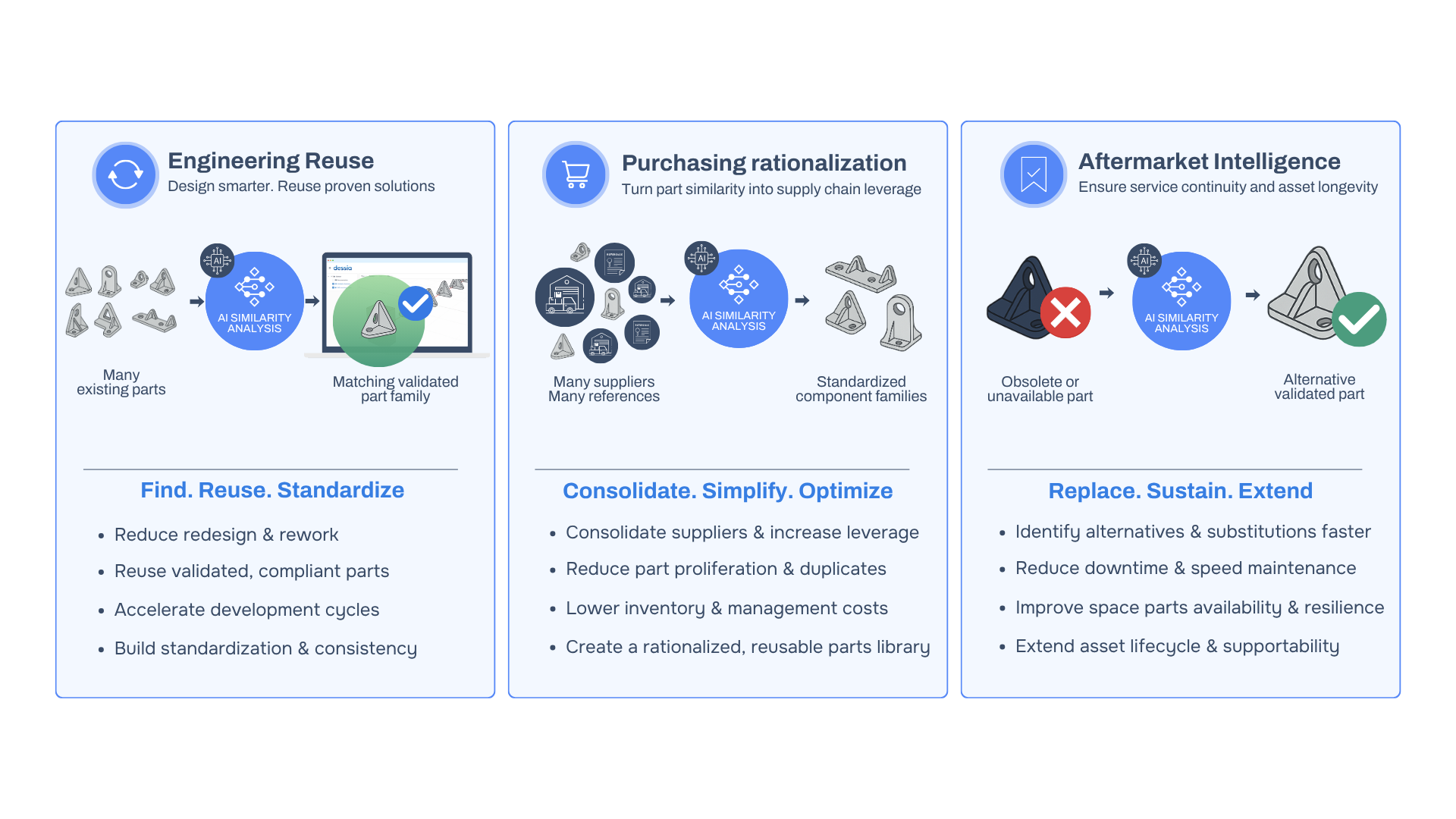
Phase 1: Engineering reuse : Stopping organizations from reinventing the wheel
One of the most common and costly forms of knowledge loss occurs during product development. Engineers frequently create new parts because they are unaware that similar, validated solutions already exist somewhere in the organization.
The problem is rarely a lack of data. It is finding the right information among thousands — or millions — of existing components, across programs, generations, and business units.
By leveraging AI-powered geometric similarity analysis, metadata comparison, and automated part classification, organizations can automatically identify existing parts that closely match a new design requirement.
This enables engineering teams to:
Reuse validated, compliance-tested designs and enforce design governance
Accelerate development cycles and reduce time-to-market
Eliminate unnecessary design effort and rework through systematic design reuse
Drive component standardization and maintain design consistency across programs
Maximize return on previous engineering investments by managing reusable part families
Instead of starting from a blank page, teams start from proven solutions. Engineering knowledge becomes cumulative rather than fragmented.
This is the foundation of what leading organizations call a knowledge-based engineering (KBE) strategy, and AI is finally making it scalable.
Phase 2: Purchasing rationalization: Turning part similarity into supply chain intelligence
Engineering complexity compounds directly into supply chain complexity.
Over time, organizations accumulate thousands of parts that perform similar functions but are sourced separately, manufactured to slightly different specifications, or managed through different suppliers. This part proliferation is one of the most persistent cost drivers in industrial manufacturing — and one of the clearest targets for purchasing rationalization.
It increases:
Procurement and supplier management costs
Inventory complexity and working capital requirements
Manufacturing variability and quality management overhead
Time spent on supplier qualification and auditing
AI-powered similarity analysis enables purchasing and sourcing teams to identify clusters of functionally comparable components across large, multi-generation product portfolios — making component rationalization systematic rather than opportunistic.
By understanding which parts share common geometric, functional, or performance characteristics, organizations can:
Consolidate supplier negotiations and increase purchasing leverage through supply base rationalization
Standardize component families and reduce duplicate references via parts standardization programs
Simplify catalog management and reduce obsolescence risk
Create a rationalized, reusable master parts library aligned to engineering standards
Build a foundation for variant management across product lines
This transforms engineering knowledge into a strategic lever for supply chain cost optimization and BOM rationalization — one of the highest-ROI applications of AI in manufacturing today.
Phase 3: Aftermarket intelligence and service continuity : Finding alternatives when parts become obsolete
Engineering knowledge reuse becomes even more critical after products enter service.
Many industrial products — aircraft, rail systems, defense equipment, power generation assets — remain operational for 20, 30, or 40 years. During that time, suppliers consolidate or disappear, components reach end-of-life, and original references may no longer be procurable. This is the core challenge of obsolescence management and sustainment engineering.
When a critical replacement part becomes unavailable, organizations face a costly, time-consuming search for alternatives. Traditionally, this relies on tribal knowledge and manual investigation — exactly the kind of expertise that retires with senior engineers.
AI-driven design similarity introduces a more systematic, scalable approach. By analyzing geometric characteristics, functional requirements, interfaces, mounting conditions, and operational constraints, organizations can systematically identify alternative parts that may satisfy the same engineering need.
This capability enables:
Faster maintenance operations and reduced asset downtime
Improved spare part availability and supply chain resilience through intelligent parts interchangeability analysis
Lower total lifecycle costs through proactive obsolescence mitigation
Extended product supportability without costly redesigns
Reduced dependency on individual expert knowledge for critical substitution decisions
Rather than relying on tribal knowledge alone, service teams can leverage decades of historical engineering data — transformed by AI into actionable, searchable intelligence.
The organizations that win will be those that can reuse what they already know
Industrial companies are entering a new era in which engineering expertise — not raw data volume — is the defining competitive asset.
The organizations that will pull ahead are not necessarily those generating the most data. They are those capable of transforming existing engineering data into structured, reusable knowledge — and deploying AI agents that can act on it across the digital thread.
Whether enabling engineers to discover previously validated components through intelligent design reuse, helping procurement teams execute parts rationalization and supply base consolidation, or supporting aftermarket teams in identifying substitute components through interchangeability analysis, AI-powered engineering knowledge reuse is emerging as a foundational capability for modern industrial competitiveness.
The next challenge for industrial organizations is no longer digitalization alone.
It is making decades of accumulated engineering knowledge discoverable, actionable, and reusable across the entire product lifecycle — from concept design to end-of-life service.
For many organizations, AI-powered similarity analysis and engineering intelligence platforms are becoming the most effective path to achieving it.
Frequently Asked Questions
What is engineering knowledge reuse?
Engineering knowledge reuse is the practice of systematically identifying and applying existing validated designs, components, and engineering decisions to new projects, rather than redesigning from scratch. AI-powered platforms like Dessia enable this at scale by analyzing geometric similarity, functional equivalence, and historical usage patterns across large component libraries — turning passive archives into active, queryable engineering intelligence.
Why do industrial organizations struggle with knowledge reuse?
The primary barrier is engineering data fragmentation — critical knowledge is distributed across CAD, PLM, ERP, and document systems that don't communicate. Without AI-powered search and similarity analysis, engineers have no practical way to discover relevant precedents across programs or business units. Platforms like Dessia address this by connecting these data sources and making existing knowledge discoverable through AI.
How does AI enable engineering knowledge reuse?
AI enables knowledge reuse through geometric similarity analysis, knowledge graphs, and pattern recognition applied to historical engineering data. This transforms passive data archives into active, queryable knowledge systems that can surface relevant design precedents, identify substitute components, and support purchasing rationalization automatically. Dessia's engineering intelligence platform applies this approach to help industrial companies — including Renault, Airbus, and Safran — reuse validated designs and avoid redundant engineering effort.
What is part proliferation and how can AI reduce it?
Part proliferation is the accumulation of thousands of functionally similar but separately managed components across a product portfolio. AI-powered similarity clustering helps purchasing and engineering teams identify redundant parts, consolidate supplier relationships, and standardize component families — reducing procurement costs and supply chain complexity. Dessia applies this capability to help organizations rationalize their part libraries and increase purchasing efficiency at scale.
What is the engineering intelligence gap?
The engineering intelligence gap is the distance between the data an organization owns and the decisions it can actually make from it. It arises when engineering knowledge is stored but not structured, searchable, or accessible to the teams and AI systems that need it. Dessia was built specifically to close this gap — connecting CAD and PLM data with AI to make decades of accumulated engineering knowledge actionable across the full product lifecycle.
Most industrial AI pilots fail to scale because they add AI on top of fragmented engineering data (CAD, PLM, requirements, BOMs, test reports) instead of connecting that data first. An Engineering Intelligence Layer turns disconnected engineering files into a connected knowledge graph, giving AI the context it needs to produce trustworthy, traceable engineering decisions—not just plausible-sounding text.
Your CAD models show what was designed. Your engineering rules explain why. Discover how Dessia's CAD-aware AI turns engineering rules into executable engineering knowledge — capturing your organization's expertise so AI can apply it automatically.
Most AI projects in engineering never leave the proof-of-concept stage — and it's not a technology problem. Discover the 6 steps that turn engineering knowledge, data, and expertise into real AI value: from spotting the right bottlenecks to building lasting engineering intelligence.